

12 Proven Technical Analysis Rules for Stock Traders in 2025

12 Proven Technical Analysis Rules for Stock Traders in 2025
Introduction
You want an edge you can execute on any major stock exchange—clearly, consistently, and without region-specific jargon. This practical guide focuses on technical analysis for stocks markets in 2025 with globally relevant rules, neutral currency examples, and workflows you can run during your local market hours. Where useful, you’ll see links to neutral investor-education resources and to Deeptracker AI tools that help you automate the repetitive parts of research while keeping your decision-making transparent.
What You’ll Get From This Global-Focused Guide
- A market step-by-step workflow you can run each trading day (regular session and extended hours where available).
- Indicator settings and pattern checklists that fit most liquid equities worldwide (e.g., 50/200-day trend, RSI(14), MACD(12,26,9)).
- Risk and position sizing expressed in your base currency with ATR-based stops.
- How to combine price action, volume, breadth, and newsflow without overfitting.
Before You Begin: Market Structure & Personal Risk
Educational use only. Trading rules, leverage, and tax treatment vary by country. Always review your broker’s risk disclosures, your local exchange’s trading calendar, and applicable regulations from your local securities regulator. For neutral investor education, see the International Organization of Securities Commissions (IOSCO) and the World Federation of Exchanges (WFE) education resources.
The 12 Rules You Can Apply Today
Your main playbook is built around the title’s number. Below are exactly twelve rules—concise enough to action, comprehensive enough to stand on their own. Follow them in order for the first month; afterwards, adapt with your journal data.
1. Define the tradable universe before the open
Build a watchlist that respects your capital, liquidity needs, and risk tolerance. Typical filters: primary listing on a major exchange, average daily volume ≥ 1,000,000 shares (or an amount consistent with tight spreads in your market), price range that suits your account size, and optionability if you hedge with options. Run your screener before your local open to avoid chasing noise.
2. Trade in the direction of the dominant trend
Start at the weekly, then the daily. A common convention is price above the 200-day simple moving average (SMA) for long bias, below for short bias; combine with the 50-day for momentum slope. This simple heuristic aligns you with larger flows across global markets.
3. Let momentum confirm—don’t predict it
Use RSI(14) for momentum regime and MACD(12,26,9) for impulse confirmation. Don’t try to “call tops”; align with the push when it starts, using divergences to tighten stops—not to fade trends blindly.
4. Make volume your truth serum
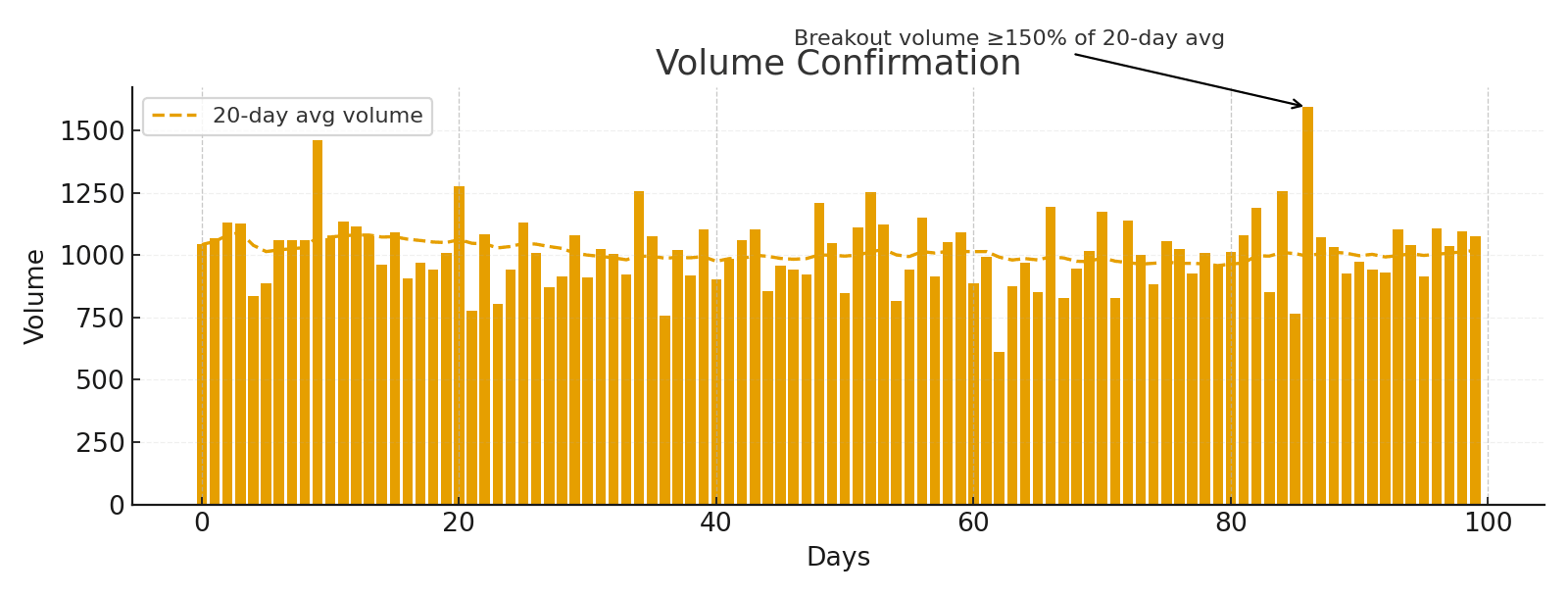
Breakouts and breakdowns need participation. Compare today’s volume to the 20-day average; moves that exceed ~150% of the 20-day average through prior highs/lows are far higher-quality than lonely prints. If price moves on weak volume into resistance, scale smaller or stand down.
5. Draw levels the same way every time
Mark monthly/weekly highs and lows, the prior day’s high/low/close, and pre-market or auction extremes if applicable. Use horizontal lines and avoid clutter. When price approaches a level with expanding volume and positive tape, plan an A-setup; otherwise, demand more confirmation.
6. Let volatility set your stop and size
Use ATR(14) on the daily to define the typical range. Initial stops of 1.0–1.5× ATR below the entry (for longs) respect how far a stock normally wiggles. Then size shares (or units) to keep the risk per trade constant (e.g., 0.5%–1.0% of equity in your base currency).
7. Only take A-setups at confluence
An A-setup has at least three independent supports: trend alignment, momentum confirmation, and a key level with above-average volume. Add breadth (e.g., advance/decline or sector indexes) for market context. No confluence, no trade.
8. Treat the close as a decision point
Institutional rebalancing often clusters near the close. Multi-day breakouts tend to “stick” if they close in the top decile of the day’s range on strong volume. Prefer adds into the close to adds mid-session, provided liquidity is adequate in your market.
9. Have a written exit plan before entry
Define both stop loss and profit objectives. Trail stops under swing lows or a short-term EMA when momentum is your edge; scale out at measured targets (e.g., prior swing high) when range is your edge. Never move a stop farther away.
10. Journal every execution and hypothesis
Record ticker, thesis, entry, exit, stop, target, market context, and emotional state. Tag mistakes by category (late entry, news chase, size too big). Review weekly to prune what doesn’t work.
11. Respect catalysts and news windows
Earnings, guidance, corporate actions, and regulatory headlines can swamp technicals. For single-stock events stand down, reduce size, or widen stops logically. When macro data or central bank decisions hit, liquidity can thin—trade smaller or wait for the dust to settle.
12. Keep your playbook simple, repeatable, auditable
If you can’t explain your pattern in two sentences, it’s probably curve-fit. Favor rules you can audit month-over-month. This lets you course-correct under your local brokerage and tax realities (commissions, slippage, holding-period rules).
Indicator & Pattern Settings That Travel Well Across Markets
Below are common, practical settings many equity traders use globally. These are conventions, not laws—test and adapt in your platform in 2025.
Indicator | Preset | Usage Notes | Reference |
|---|---|---|---|
SMA | 50 & 200 days | Trend direction & momentum alignment | |
EMA | 8 & 21 days | Short-term momentum and pullback rhythm | |
RSI | 14 period | Regime/momentum & divergence | |
MACD | 12, 26, 9 | Impulse confirmation & trend resumption | |
ATR | 14 period | Volatility-based stop distance |
A Market-Agnostic Technical Workflow You Can Run Daily
This section is intentionally detailed and operational—designed to be 20%+ of the total playbook. You’ll walk through a single session from pre-market prep to the closing auction and post-market journaling, adaptable to your local exchange hours.
- Pre-Prep: Check overnight index futures or regional index ETFs for directional bias. You’re extracting context, not predictions. Log sector leaders/laggards.
- Calendar & Catalysts: Scan the calendar for earnings, guidance, corporate actions, and regulatory events for the tickers you track. Mark binary events—tighten rules, reduce size, or avoid.
- Universe & Levels: Apply your watchlist filters (liquidity, price, float). Draw the prior day’s high/low/close; mark pre-market or call auction extremes and higher time-frame levels (weekly, monthly).
- Game Plan: Pick two A-setups only. Write your entry, invalidation, and scale plan. If you can’t write it, you can’t trade it.
- Open: Focus on tape, spreads, and volume vs. 20-day average. Only execute if the first pullback holds above your level (for longs) with volume confirming.
- Mid-Session: Avoid boredom trades. Set alerts at levels. Add on strength when a higher low forms with rising volume.
- Power Hour / Close: Judge whether a breakout is likely to close strong. If yes, consider end-of-day adds with a defined stop under the afternoon higher low.
- Journal: Record outcomes, tags, and improvements. Screenshot charts and annotate levels you respected and the ones you ignored.

Where Deeptracker AI slots in: Offload mechanical tasks so you can focus on execution quality. For example, use market dynamics analysis to surface regime shifts across sectors, signal filtering to suppress low-quality breakouts, and financial news sentiment analysis to flag headlines most likely to move your tickers in 2025.
Risk Management & Position Sizing (Currency-Agnostic)
This second deep-dive section is likewise designed to account for ~20% of the guide, because risk is the only thing you truly control. Use the fixed-risk model below; it’s simple, auditable, and adaptable across markets.
Risk Budgeting in Your Base Currency
Pick a fixed per-trade risk in your base currency. Suppose your account is 100,000. At 0.75% risk per trade, you risk 750 per idea. If your stop is 1.50 away from entry, you buy 500 shares (because 500 × 1.50 = 750). If the stock trades at 40.00 and your stop is 38.50, your size is 500 shares. That’s it—no subjectivity.
ATR-Anchored Stops
Compute 1.25× ATR(14) to place a volatility-aware stop that avoids normal noise. If ATR is 1.20, your stop sits 1.50 away from entry (1.25 × 1.20 ≈ 1.50). This ties risk to how the stock “breathes” in your market.
Scaling Logic That Respects Liquidity
- Initial: Half size at the first valid break with confirmation.
- Add 1: On a higher low above your breakout level on rising volume.
- Add 2: Only if the stock holds VWAP or your preferred intraday anchor into the afternoon.
- Trail: For momentum plays, trail under the 8-EMA on the 30-min. For range plays, take profits at measured move targets.
Risk Checklist (Print This)
Item | Yes/No | Notes | Reference |
|---|---|---|---|
Defined risk per trade | e.g., 0.75% of equity | ||
Volatility stop set (ATR-based) | ≥1.0× ATR(14) | ||
Catalyst risk assessed | Earnings/regulatory/news events | ||
Liquidity adequate for size | Spreads, depth, auction dynamics |
Combining Price Action With AI—Without Overfitting
Most traders either over-rely on indicators or over-trust AI. Your edge is the blend: simple, human-auditable rules guided by machine-filtered noise control. Here are practical ways to apply Deeptracker AI alongside your charts:
- AI signal filtering to suppress breakout attempts that lack adequate volume or sector confirmation.
- News sentiment analysis to elevate headlines that statistically precede volatility.
- Market dynamics dashboards to score trend regime (trend vs. mean reversion) so you pick the right playbook.
- AI stock picker to build a liquid watchlist that respects your risk budget and time horizon.
- Investment strategy modules to codify and backtest your 12 rules—then deploy the subset that actually works for you in 2025.
Candles, Structures, and Traps You’ll See Across Stock Markets
Price tells the story if you learn the grammar. Start with the handful of structures below; they cover most of what matters day-to-day across liquid equities.
Pattern | Context | Invalidation | Reference |
|---|---|---|---|
Bullish Breakaway Gap | Above well-defined resistance with volume > 150% of 20-day | Close back into gap on rising volume | |
Failed Breakout (FB) | Wick above level; close back below on low volume | Reclaim and close above level with volume | |
Higher-Low Pullback | After breakout, pullback holds prior resistance turned support | Lower low on expanding sell volume | |
Bearish Reversal at Long-Term Average | Rejects the 200-day SMA with momentum divergence | Close above the average on strong breadth |
From Rules to Playbooks: Three Templates for Equities
Breakout Trend Play
- Setup: Price above 50/200-day; base near highs; sector breadth positive.
- Trigger: Break through resistance with 150%+ 20-day volume; add on higher low.
- Risk: Initial stop 1.25× ATR below entry; trail under 8-EMA after first consolidation.
Mean Reversion Within Trend
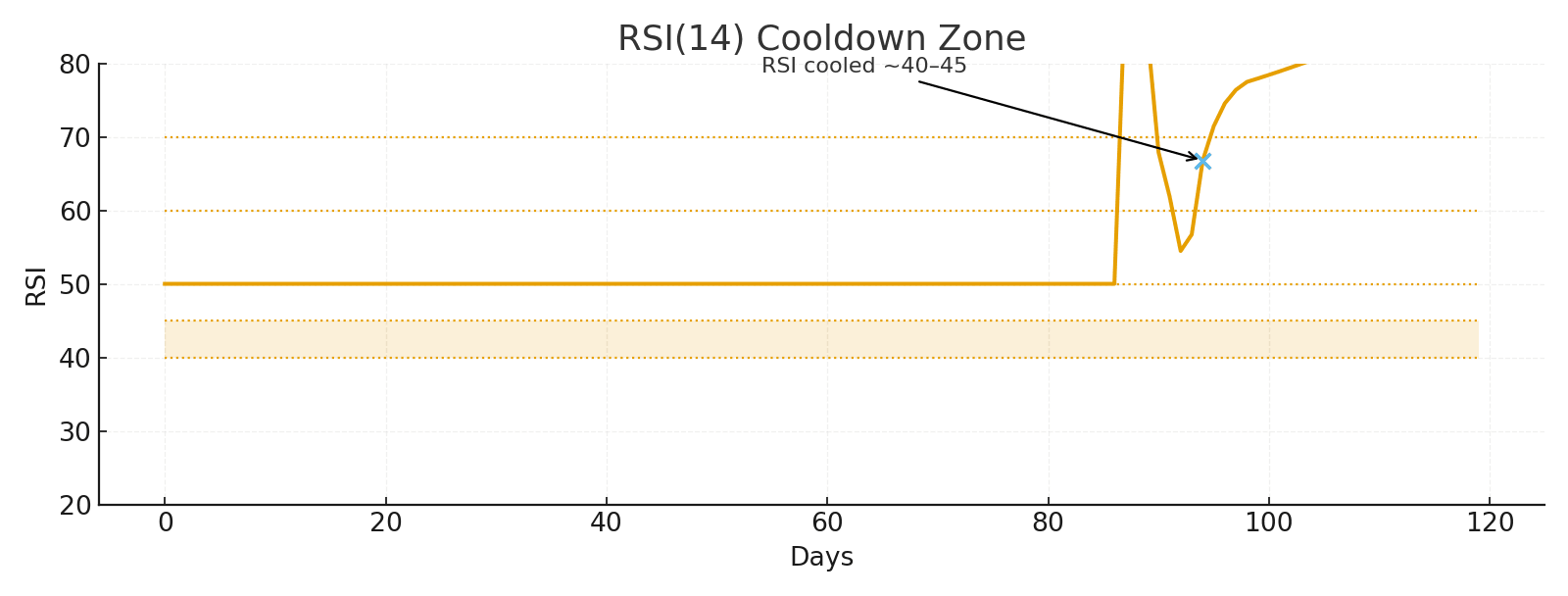
- Setup: Healthy uptrend; RSI cools to 40–45; pullback into rising 21-EMA.
- Trigger: Bullish reversal candle + rising volume.
- Risk: Stop below swing low; target prior high; partials at VWAP reclaim.
Range Fade (Experienced Only)
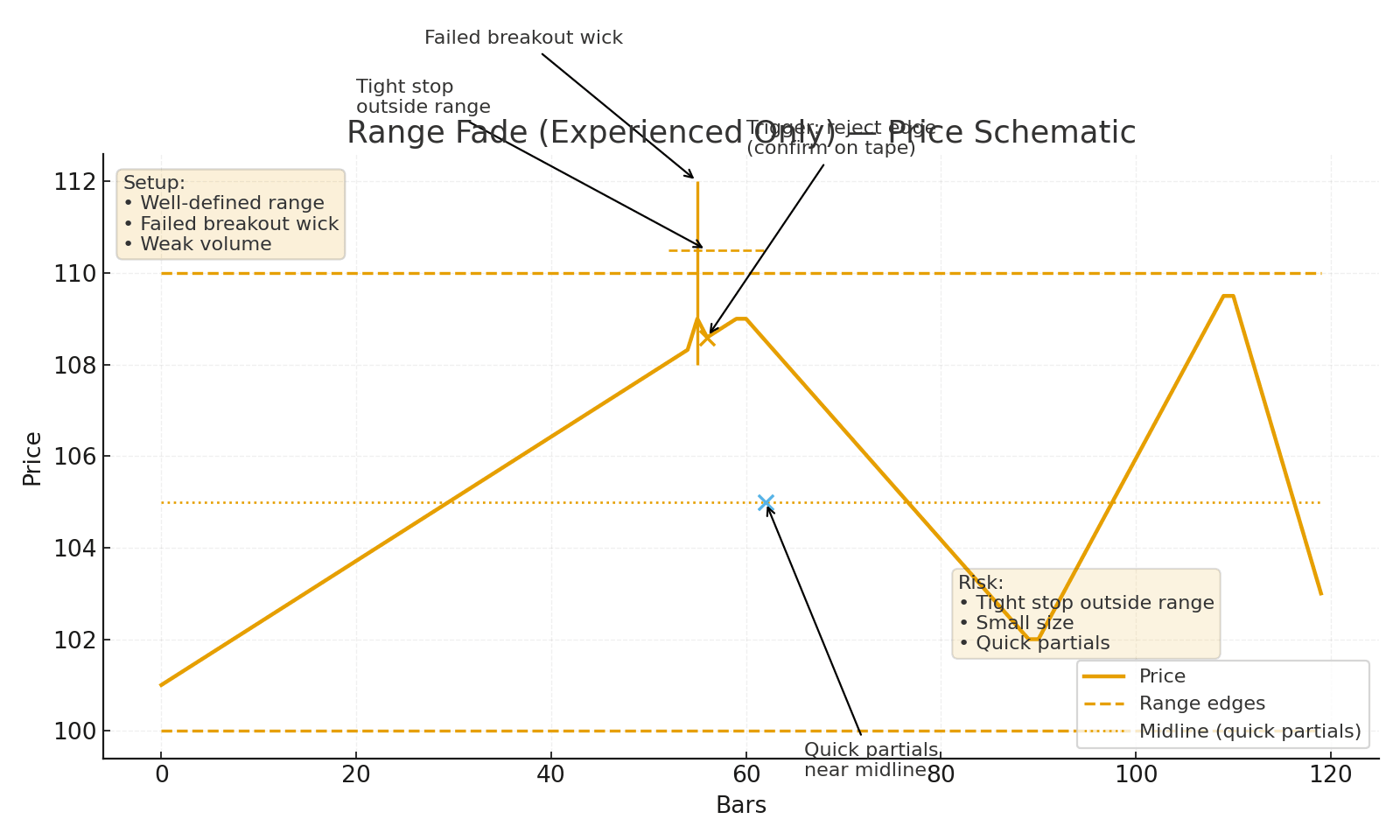
- Setup: Well-defined range; failed breakout wick; weak volume.
- Trigger: Reject range edge with confirmation on tape.
- Risk: Tight stop outside the range; small size; quick partials.
Backtesting and Iteration: Make It Real
Technical analysis becomes powerful when you measure your own implementation. Create a minimal backtest of two or three rules, not all twelve at once, and run it across your chosen universe. Focus on execution-quality stats: hold time, max adverse excursion (MAE), and profit factor during your market’s main session only in 2025.
DIY Backtest Checklist (Adapt for Your Platform)
- Universe defined (liquidity, price, sector)
- Rules encoded (e.g., price above 200-day; volume filter)
- Slippage/fees realistic for your market
- Out-of-sample test preserved
- Journal links to trades with screenshots
Where Deeptracker AI helps: Use investment strategy to turn rules into parameterized strategies, then push them through AI tracking so your forward test matches your backtest assumptions. Use the portfolio analyzer to view contribution by ticker and time-of-day, and AI balance sheet analysis for fundamentals context.
Putting the 12 Rules Into a Weekly Cadence
- Day 1: Fresh watchlist; sector themes; two A-setups max.
- Days 2–4: Execute, add on higher lows, journal daily.
- Day 5: Reduce exposure into the close; weekly review; export screenshots and metrics.
Case Study: From Thesis to Execution
Example for learning—numbers illustrative, not a recommendation. You identify a mid-cap above the 200-day, basing under resistance for three weeks. On Thursday, volume surges to 1.6× the 20-day average and price breaks the level. You enter with a 1.40 ATR stop (1.25× ATR). The stock holds VWAP into the close; you add a quarter size. Friday closes at the top decile of the day’s range. The next week, you trail under the 8-EMA and scale out at the prior swing high. Your journal tags: “trend alignment,” “volume confirmation,” “close add.”
Your 12-Rule Template (Copy/Paste)
1. Universe
Liquid equities, sensible price band, adequate volume.
2. Trend
Longs only if price above 200-day and 50-day rising.
3. Momentum
RSI(14) not extended; MACD upturn for confirmation.
4. Volume
Breaks must exceed ~150% of 20-day average volume.
5. Levels
Monthly/weekly/prior day h/l/c + opening/auction extremes.
6. Stops
~1.25× ATR(14) from entry; no widening.
7. Adds
Only on higher lows above the level with rising volume.
8. Time
Favor the first hour and last hour; avoid mid-day drift.
9. Exits
Trail for momentum; take measured targets in ranges.
10. Journal
Every trade with tags and screenshots.
11. Catalysts
Size down or avoid around earnings/regulatory events.
12. Review
Weekly refinement based on data—not opinions.
Trusted Global Learning & Definitions
For unbiased, global investor education, start here:
Final Notes for Traders in 2026
In 2026, you win by keeping it simple, liquid, and repeatable. Align to trend, demand volume, respect volatility, and journal relentlessly. Let AI handle the drudge work, but keep your discretionary rules the single source of truth. When in doubt, do less, size smaller, and wait for confluence.
People Also Ask
How do I start technical analysis for stocks if I work full-time?
Run the daily workflow on the close. Build watchlists after hours, set alerts at key levels, and execute only A-setups the next day. Use Deeptracker’s AI tracking to monitor signals while you’re off the desk.
What are the best indicator settings for beginners in 2025?
SMA(50/200), RSI(14), MACD(12,26,9), ATR(14). They’re common across liquid equities and easy to audit. Start simple, then specialize.
How do I avoid news-driven whipsaws?
Tag catalysts on your calendar, reduce size near events, and wait for post-event structure to rebuild. Add only on confirmed higher lows or retests with volume.
Can AI replace my charts?
No. Use AI to filter and prioritize , but keep decisions grounded in your 12 rules and journal.