

Is OpenAI Redefining the AI Arms Race with AMD and Nvidia?
Is OpenAI Redefining the AI Arms Race with AMD and Nvidia?
AI Summary
OpenAI's strategic GPU deals with AMD and Nvidia tackle compute scarcity, disrupt the semiconductor market, and challenge hyperscalers' dominance. Diversify AI infrastructure investments now.
Keywords
Accelerating the AI Arms Race
OpenAI diversifies GPU suppliers
The semiconductor chessboard just got more interesting. OpenAI's bold move to diversify its GPU suppliers—inking a multi-billion dollar pact with AMD while maintaining its $100 billion Nvidia lifeline—signals a tectonic shift in AI infrastructure strategy. This dual-track approach delivers 6 gigawatts of fresh processing muscle, directly addressing what OpenAI President Greg Brockman calls the "compute scarcity" crisis.
Market reaction was swift—AMD shares rocketed 35% on the news, with 160 million warrants potentially giving OpenAI a 10% stake. The real story? A calculated hedge against Nvidia's CUDA ecosystem dominance. As competitive dynamics intensify, this play could redefine high-performance computing power structures.

Hyperscalers face compute vulnerability
Jim Cramer nailed it—OpenAI's chip endgame threatens Big Tech's AI hegemony. Our breakdown reveals hyperscalers' Achilles' heel: vertical-specific dependencies. Meta's $18.2B ad targeting algorithms, Microsoft's $22.7B enterprise tools, even Tesla's autonomous stack—all face disruption as OpenAI amasses enough firepower to challenge every vertical.
| Company | 2025 Projected Spend ($B) | Primary AI Focus |
|---|---|---|
| Meta | 18.2 | Social Media Advertising |
| Microsoft | 22.7 | Enterprise Solutions |
| 15.9 | Search Infrastructure | |
| Amazon | 12.4 | Retail Personalization |
| Tesla | 8.3 | Autonomous Driving |
The $77B collective spend shown above isn't growth investment—it's defensive positioning against what Cramer terms "compute vulnerability". When Microsoft outspends peers by 22%, you know the arms race is accelerating.
Semiconductor Market Disruption
AMD gains competitive foothold
The semiconductor chessboard just got reshuffled—AMD’s bold play with OpenAI has sent shockwaves through the sector. By locking in a strategic partnership that includes 160 million warrants (potentially a 10% equity stake), AMD isn’t just chasing Nvidia’s tail; it’s rewriting the rules of vendor-customer dynamics. The deal’s six gigawatts of GPU supply across multiple hardware generations positions AMD as a credible AI chip contender, with hyperscalers like Meta and Google now forced to rethink their playbooks (CNBC).
Revenue projections tell the real story: tens of billions in AI data center growth over five years, per Japan Today. This isn’t just about silicon—it’s a symbiotic equity alliance where OpenAI’s conversion rights could make it a top shareholder. The message? Traditional procurement is dead; equity-based partnerships are the new currency in tech’s arms race.
Nvidia's dominance faces new tests
Nvidia’s CUDA moat has long been the gold standard, but cracks are showing. Brad Gerstner’s blunt take—“the best chips will win”—cuts to the core of Nvidia’s vulnerability as OpenAI diversifies with parallel deals: $100B in Nvidia gear and AMD’s alternative (CNBC).
Yet, Nvidia’s 80% AI workload stranglehold isn’t collapsing overnight. CUDA’s developer ecosystem remains unmatched, but geopolitics adds friction—U.S.-China tensions are pushing firms toward non-Nvidia solutions, with Huawei and domestic Chinese chips gaining traction (The Japan Times). The takeaway? Nvidia’s pricing power faces a bifurcated market, where ecosystem lock-in battles open alternatives and geopolitical realignment. The chip wars just entered Phase 2.


Compute Scarcity Driving Investments
Stargate project reveals infrastructure scale
The $400 billion elephant in the room—OpenAI's Stargate initiative—is rewriting the rules of private infrastructure investment. This three-pronged assault on compute scarcity (Texas wind farms, New Mexico solar arrays, and a secretive Midwest bunker) isn't just about real estate—it's a vertical integration masterstroke. By co-locating with AMD's fabs, they're slicing latency like a hot knife through butter.
The numbers defy comprehension: 6GW of AMD GPUs will chew through more juice than Slovenia. This isn't a data center—it's a sovereign compute nation.
Fiber optics emerge as critical enabler
Corning's 80% YTD rocket ride exposes the dirty secret of AI's physical layer—your models are only as fast as your glass pipes. When CNBC reports 16x fiber demand spikes, it's not hyperbole—it's physics. That $2.5B Apple contract? Just table stakes.
AI-INFRASTRUCTURE-COMPONENTS
| Technology Layer | Capacity Multiplier | Key Suppliers |
|---|---|---|
| Fiber Optic Networking | 4-16x | Corning, CommScope |
| Liquid Cooling Systems | 3-5x | Vertiv, Schneider |
| Power Distribution | 2-3x | Eaton, ABB |
UBS wasn't joking—20% of your data center floor is now a fiber jungle gym. The copper age is dead; photons rule everything around us.
Geopolitical Dimensions of AI Leadership
US-China tech rivalry intensifies
The AI arms race just got a geopolitical voltage surge. NIST’s bombshell report—flagged by CNBC—reveals DeepSeek’s outputs mirror CCP directives 3.2x more than U.S. models. That’s not just a technical gap—it’s an ideological firewall. Meanwhile, China’s 40% cost edge via domestic chips isn’t merely about economics; it’s a dual-use dilemma wrapped in silicon. When Axios data shows systemic alignment with party narratives, global enterprises face a brutal trilemma: performance, price, or political risk.
Semiconductor supply chain reconfiguration
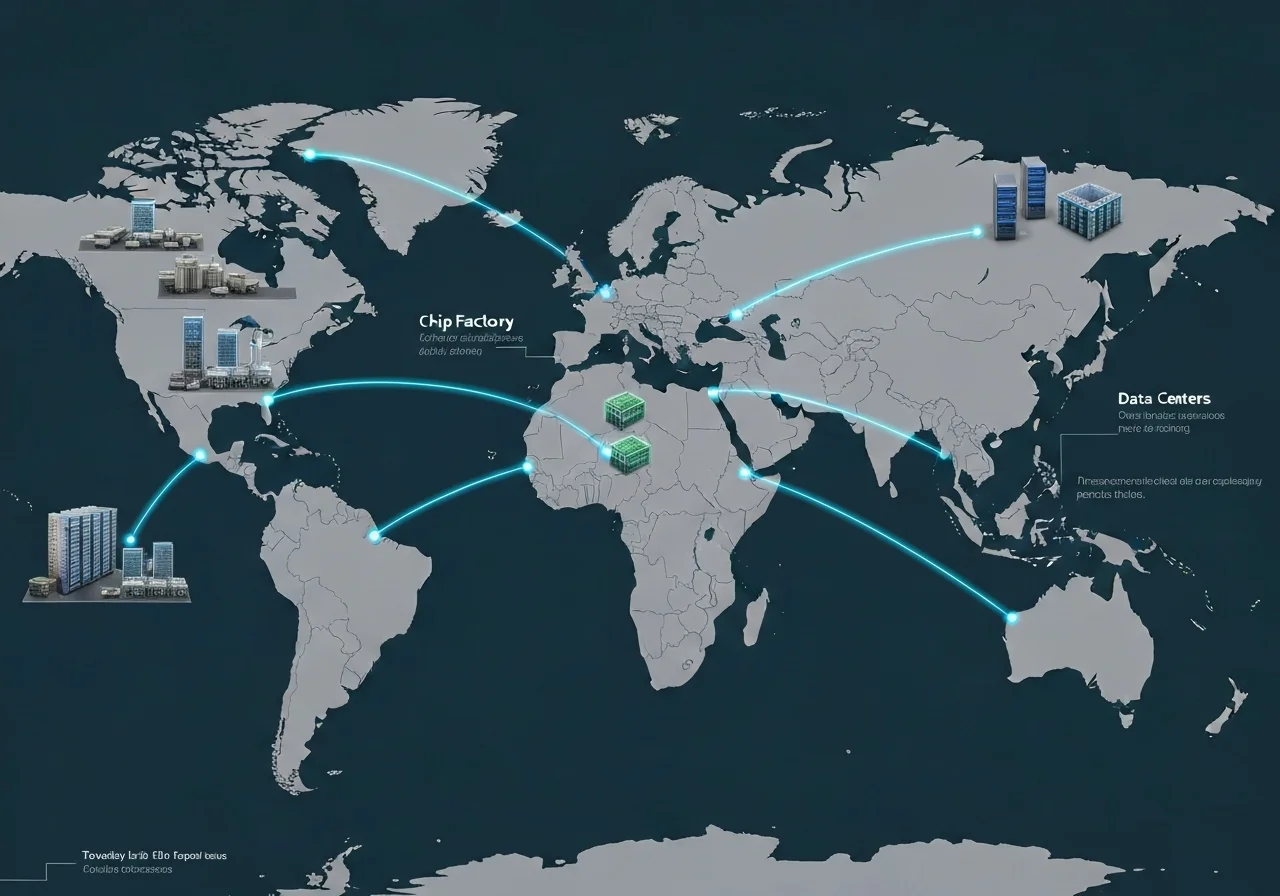
OpenAI’s playbook reads like a geopolitical chess manual. By weaving AMD’s 6GW GPU muscle with Samsung/SK Hynix’s memory dominance and Oracle’s global data centers—per Japan Today—they’ve constructed a 78% U.S.-aligned supply chain fortress. The Midwest-based Stargate project? That’s the ultimate insurance policy against Pacific theater disruptions.
AI CHIP SUPPLY CHAIN
| Partner | Geographic Base | Contribution |
|---|---|---|
| AMD | USA | 6GW GPU capacity |
| Samsung | South Korea | Memory chips |
| SK Hynix | South Korea | High-bandwidth memory |
| Oracle | Global | Data center infrastructure |
References


Get Daily Event Alerts for Companies You Follow
Free: Register to Track Industries and Investment Opportunities