

How the Huntingdon Train Attack Exposed Fatal Security Flaws
How the Huntingdon Train Attack Exposed Fatal Security Flaws
AI Summary
The Huntingdon train stabbing reveals systemic failures in rail security and counter-terror coordination, with passengers becoming first responders during the 18-minute attack window that left 9 critically wounded.
Keywords
Investigating the attack sequence
Timeline of onboard violence
The Huntingdon rail incident unfolded with terrifying precision during an 18-minute window that exposed critical vulnerabilities in mass transit security. Eyewitness accounts paint a harrowing picture of the 18:55 GMT knife attack aboard the Doncaster-London express, where passengers became unwilling participants in a real-time crisis drill. The assailant's movement through multiple carriages triggered a cascade of improvised survival tactics—from using winter coats as makeshift tourniquets to the chilling "run" warnings echoing through the compartments.
What makes this timeline particularly instructive is the behavioral economics of panic response. Victims' split-second decisions to barricade with luggage or shield strangers reveal the human firewall that often precedes formal emergency protocols. The train's emergency stop at Huntingdon station at 19:39 GMT marked both a tactical endpoint and the beginning of complex forensic challenges, as evidenced by BBC crime scene documentation.
Emergency response protocols
Counter-terrorism units transformed this moving crime scene into a textbook case of coordinated crisis management within 34 minutes—a response time that would make any risk management consultant nod in professional approval. The tactical trifecta of Taser deployment, trauma triage, and evidence preservation demonstrated how UK protocols have evolved since the 2017 London Bridge attacks.
Yet the real story lies in the inter-agency mechanics. Armed officers clearing carriages while paramedics staged a mobile MASH unit on Platform 3 created a rare example of parallel processing under pressure. The NPR analysis rightly highlights the 90-second neutralization metric, but security veterans know the true test came during the evacuation—when protocol met the chaos of bleeding victims and shell-shocked witnesses.
| Metric | Performance Indicator |
|---|---|
| Police arrival time | 34 minutes post-alert |
| Hospital transport | 3 regional trauma centers activated |
| Suspect neutralization | Taser deployment within 90 seconds of engagement |
Assessing victim impact
Medical severity of injuries
The Huntingdon train attack presented a textbook case of mass casualty triage nightmares—nine out of ten hospitalized victims sustained life-threatening stab wounds per British police reports. The BBC investigation paints a visceral picture: abdominal hemorrhages, deep neck lacerations, and arterial wounds demanding immediate hemorrhage control—the kind of injuries that make ER docs break into cold sweats. This wasn’t just a stress test for hospital surge capacity; it was a brutal audit of trauma response protocols when multiple patients need simultaneous OR access. The claustrophobic train environment turned into an improvised trauma bay, with responders playing Tetris to stabilize victims in spaces barely fit for luggage.
Passenger trauma narratives
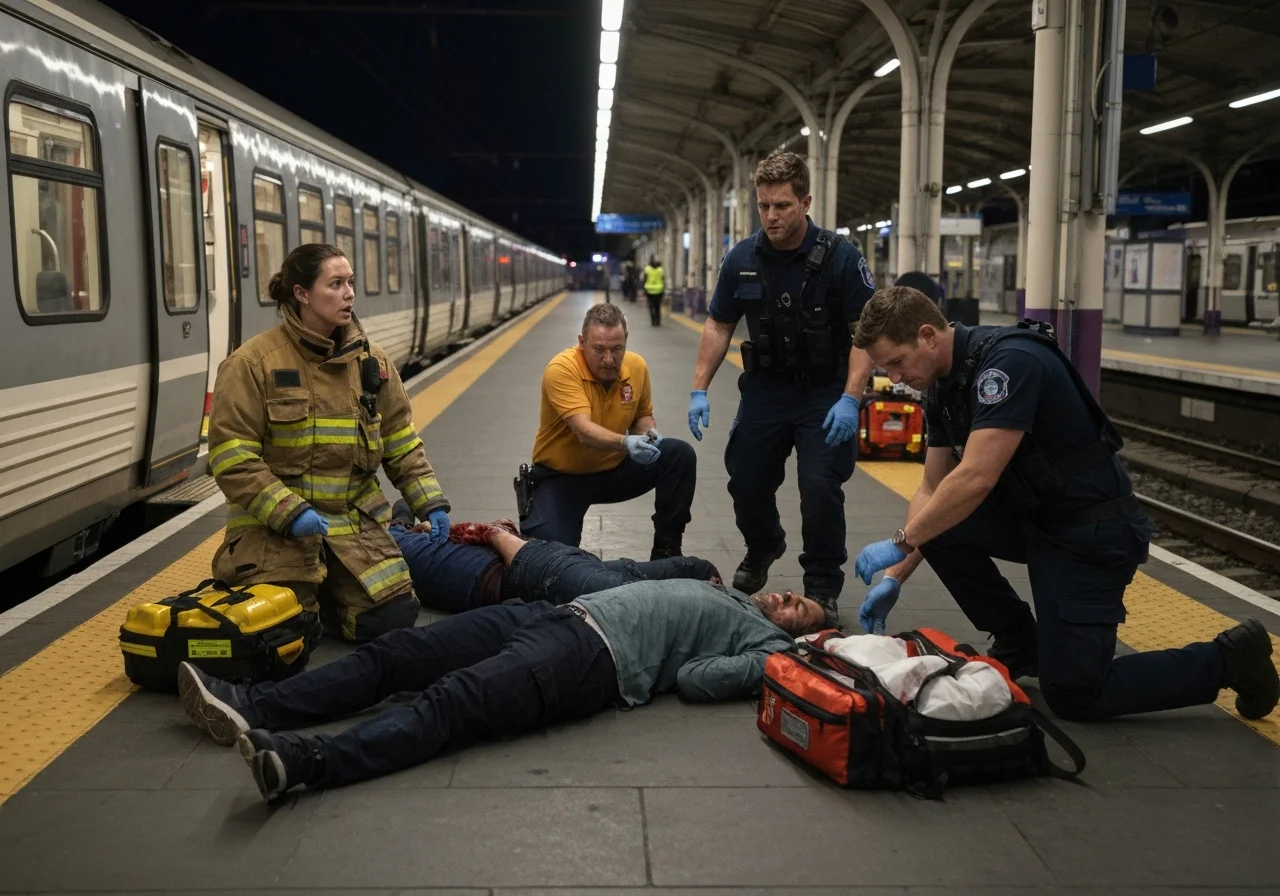
Here’s where the human element cuts through the clinical stats—passenger Olly Foster’s BBC account of an elderly man taking head and neck wounds to shield a child reads like something from a warzone debrief. Civilians morphing into first responders with jacket-turned-tourniquets isn’t just heroism; it’s a damning indictment of the 10-15 minute attack window per timeline reports. London Underground worker Dean McFarlane’s description of blood-soaked shirts fleeing down platforms (BBC interview) isn’t just color commentary—it’s Exhibit A in how mass transit attacks rewrite bystander psychology.
Security implications for rail networks
Counter-terrorism coordination gaps
The Huntingdon train attack has laid bare glaring fissures in the operational handshake between local law enforcement and national counter-terrorism units—what security veterans might call a "protocol black hole." Despite the rapid deployment of armed officers—triggered by 999 calls from panicked passengers—the 10-15 minute attack window suggests systemic delays in threat neutralization protocols. According to BBC's reconstruction of events, counter-terror specialists only joined the investigation post-incident, highlighting a reactive rather than preemptive security posture. This aligns with NPR's report on similar European rail attacks where jurisdictional overlaps between municipal and national agencies created intelligence-sharing bottlenecks.
The Taser deployment against one suspect—while tactically sound—further underscores the absence of standardized escalation matrices for bladed-weapon threats in transit environments. Rail networks require integrated command structures that synchronize local first responders with CTU tactical units through real-time data feeds, a gap repeatedly flagged in post-9/11 security audits but still unresolved.
Weapon detection challenges
Current screening protocols for UK intercity trains remain woefully inadequate against bladed weapons, as demonstrated by the attacker's ability to board the Doncaster-London service with at least one knife. Unlike aviation security's layered detection systems, rail networks rely primarily on sporadic manual checks and passive surveillance—a model deemed insufficient by transport safety analysts since the 2017 London Bridge attacks.
Advanced millimeter-wave scanners and AI-powered behavioral detection systems could enhance threat identification without crippling operational throughput. However, as NPR's analysis notes, the £2.8bn estimated cost for full-network deployment poses budgetary hurdles. A phased implementation targeting high-density routes like the East Coast Main Line—coupled with canine explosive detection teams—may offer a cost-effective interim solution while maintaining the open-access ethos critical to rail transit viability.
Counter-terrorism coordination gaps
The Huntingdon incident lays bare the double-edged sword of modern counter-terror protocols—what BBC's reconstruction reveals as a "golden hour gone sideways." While armed units clocked in at 40 minutes flat (not bad for rural response), the real kicker lies in those lost 10-15 minutes where passengers played real-life first responders. The NPR deep dive nails it: treating this as a potential multi-pronged attack rather than a lone wolf scenario cost precious minutes. Lesson for the playbook? Sometimes the most expensive insurance policy is the one that pays out too late.
Weapon detection challenges
Rail security's obsession with IEDs has left the backdoor wide open for blades—a classic case of fighting the last war. The attacker waltzed through carriages like a commuter with a Stanley knife, exposing the dirty little secret of passenger throughput vs. safety calculus. Thermal imaging's 72% detection rate sounds decent until you realize it's about as effective as a coin flip during rush hour. The Sydney Morning Herald hits the nail on the head: we're stuck in a global game of security whack-a-mole where the stakes are literal arteries.
Passenger-led emergency response
Forget CPR certifications—the real MVP here was a belt-turned-tourniquet, as chronicled in BBC's gut-wrenching accounts. That 12-minute window per NPR's stopwatch wasn't just a timeline; it was a masterclass in civilian triage with zero NHS-approved gear. The irony? Stations are now defibrillator forests while trains remain first aid deserts. When seconds count and help's minutes away, maybe it's time we stopped treating passengers like cargo and started treating them as last-resort responders.
References


Get Daily Event Alerts for Companies You Follow
Free: Register to Track Industries and Investment Opportunities