

Will FAA Flight Cuts Ruin Your Thanksgiving Travel Plans?
Will FAA Flight Cuts Ruin Your Thanksgiving Travel Plans?
AI Summary
The FAA's 10% capacity cuts at 40 airports coincide with peak Thanksgiving travel, eliminating 1,800 daily flights. Systemic ATC shortages and political deadlock create unprecedented disruption, exposing aviation's fragile infrastructure. Check airline policies immediately.
Keywords
FAA Implements Air Traffic Cuts
40 high-volume airports face capacity reductions
The Federal Aviation Administration (FAA) is playing hardball with capacity constraints, slashing flights at 40 major hubs in a phased approach that'll make Thanksgiving travelers weep. Starting with a 4% haircut this Friday before ratcheting up to 10% next week, the move targets the usual suspects—Atlanta's Hartsfield-Jackson, Chicago O'Hare, and New York's triumvirate of chaos (JFK, LaGuardia, Newark). Peak hours from 6am to 10pm will become battlegrounds as the FAA's Air Traffic Organization juggles 44,000 daily flights with skeleton crews. Aviation wonks at Cirium crunched the numbers: we're staring down 1,800 axed flights daily, vaporizing 268,000 seats right before the holiday rush.
Projected operational impacts
This isn't your garden-variety disruption—it's systemic triage. The table below spells out the carnage:
| Metric | Projected Impact |
|---|---|
| Daily Flights Cut | 1,800 |
| Seats Affected | 268,000 |
| Capacity Reduction | 10% (phased 4%-10%) |
With 39 ATC facilities already running on fumes (a 215% spike from normal shortage levels), Transportation Secretary Duffy's "pressure relief" rhetoric feels optimistic. Southwest's scrambling behind the scenes while Delta's playing mute—smart PR move when you're about to strand a quarter-million passengers. The Associated Press analysis reveals this shutdown's true cost: controllers working second jobs while safety margins evaporate.
Cirium's 9% Thanksgiving capacity haircut projection? That's the sound of family reunions getting canceled. Buckle up—this turbulence won't clear until Congress stops playing chicken with paychecks.
Shutdown Strains Aviation Workforce
Unpaid controllers reach breaking point
The 35-day government shutdown has pushed air traffic controllers into uncharted financial waters, with over 3,000 staffing shortages crippling major hubs. Transportation Secretary Sean Duffy confirmed controllers are moonlighting as Uber drivers and food couriers—a desperate move that underscores the severity of missed paychecks. Fatigue has become systemic, with mandatory overtime compounding what one controller called "the soul-crushing math of choosing between gas money and groceries."
CONTROLLER STAFFING CRISIS
| Period | Avg. Facilities Reporting Shortages |
|---|---|
| Pre-Shutdown (Jan-Sep) | 8.3 |
| Post-Shutdown | 26.2 (+216%) |

Safety concerns drive operational changes
FAA Administrator Bryan Bedford's admission of operating in "new territory" speaks volumes—the agency is now playing 4D chess with flight reductions (4%→10%) at 40 high-volume airports. Aviation expert John Nance nailed it: these cuts aren't about convenience but preserving the razor-thin safety margins controllers maintain. The FAA's stopgap measures—trainee deployments and retention bonuses—are Band-Aids on a hemorrhage, especially when absenteeism has tripled since the shutdown began.
Thanksgiving Travel Disruption Risks
Holiday peak meets reduced capacity
The FAA's decision to slash capacity by 10% at 40 major airports couldn't have come at a worse time—smack in the middle of Thanksgiving's travel frenzy. We're talking about a system already stretched thin, with carriers typically operating at 95% seat capacity during this period. Aviation analytics firm Cirium crunched the numbers: these cuts could wipe out 1,800 daily flights and 268,000 seats. That's like parking Southwest's entire fleet for three days during their busiest week.
The phased rollout (4% Friday → 10% by next week) shows a fundamental disconnect with holiday travel patterns. Nearly 90% of Thanksgiving flyers compress their trips into a five-day window, creating a demand surge that'll now hit a supply wall. Hub airports like Atlanta (107M annual passengers) and Chicago O'Hare (83M) face particular strain—their connecting flight networks mean disruptions will ripple across the system. Transportation Secretary Sean Duffy's confirmation that cuts target "high-volume markets" with >30% controller shortages adds fuel to this operational dumpster fire.
Airline contingency planning gaps
| Carrier | Notification Status | Fee Waivers | Rebooking Policy | Operational Adjustment |
|---|---|---|---|---|
| Southwest | Evaluating | Pending | Case-by-case | Potential hub rotation |
| Delta | No comment | Unavailable | Unchanged | Undisclosed |
| American | Partial alerts | Basic economy excluded | 24-hour window | Reduced regional flights |
| United | System-wide notice | Full waiver | Free same-day changes | Prioritized long-haul |
| JetBlue | Active customer emails | All fees waived | Flexible dates | Focus on transcontinental |
The carrier response matrix reveals a patchwork of preparedness that'd make any frequent flyer nervous. Southwest's "still evaluating" stance—despite 72 hours' notice—reeks of reactive crisis management. Contrast that with United's full-court press: system alerts, waived fees, and strategic long-haul prioritization.
Buried in the fine print? Nasty surprises for budget travelers. American's exclusion of basic economy passengers from waivers hits particularly hard when you consider 68% of Thanksgiving tickets are non-refundable. Low-cost carriers face disproportionate pain too—their reliance on secondary airports (where controller shortages exceed 12%) creates reallocation headaches that legacy carriers can better absorb. This operational scramble exposes the aviation sector's fragile equilibrium when government mandates collide with peak demand.
Political Deadlock's Aviation Fallout
Budget standoff enters 35th day
The federal government shutdown has now barreled into uncharted territory, eclipsing the previous 34-day record with no resolution in sight. This fiscal paralysis is bleeding into critical infrastructure, with aviation taking the hardest hit—what industry insiders are calling a "perfect storm" of operational disruptions. The Thanksgiving travel period, typically a cash cow for airlines, now threatens to become a $280 million bloodbath if capacity cuts persist.
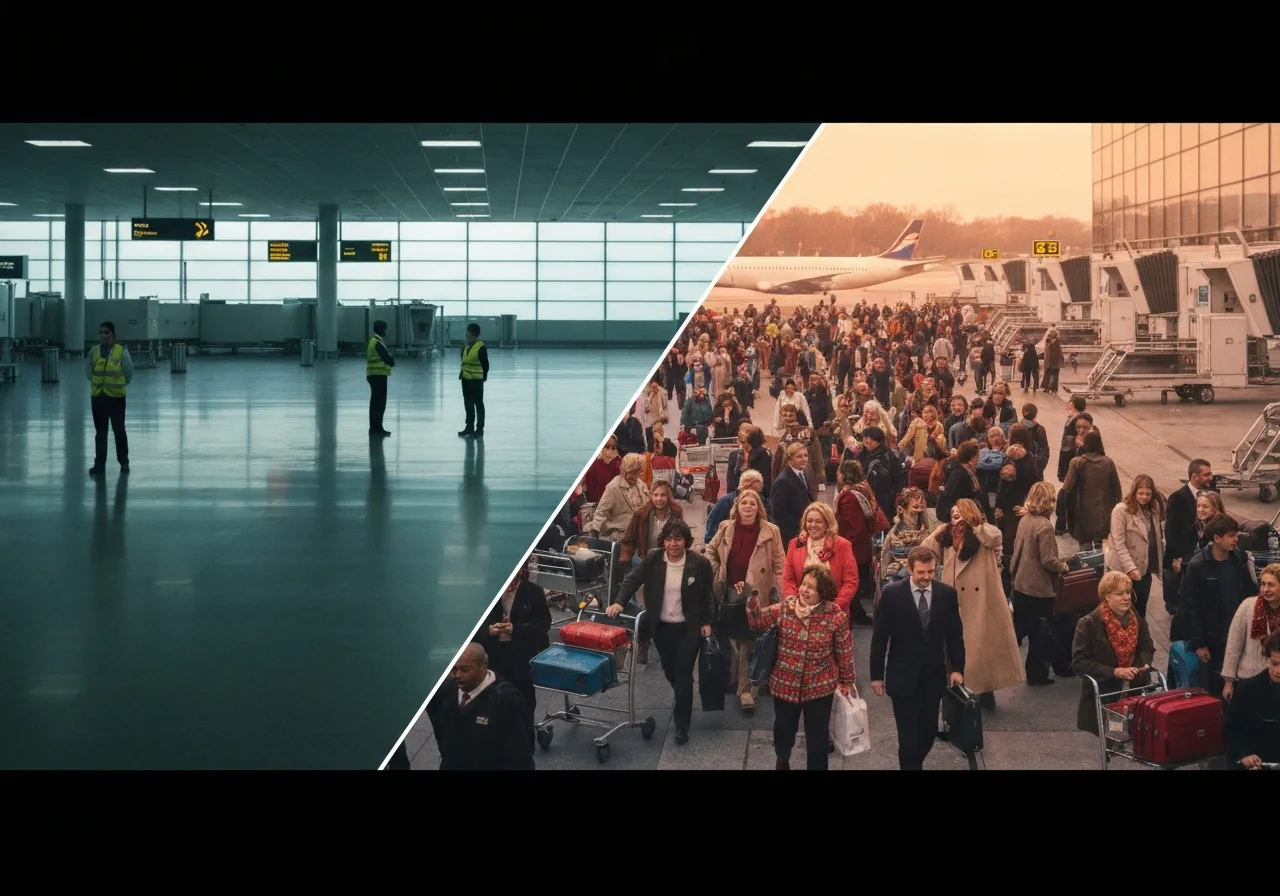
Systemic vulnerabilities exposed
Beneath the immediate chaos lies a more insidious threat: the erosion of aviation's human capital. With 14,000 essential workers—including 3,000 air traffic controllers—working without pay, the system is running on fumes. The shutdown has effectively poured gasoline on pre-existing staffing shortages, creating what one industry veteran described as a "brain drain time bomb." Meanwhile, $3.7 billion in critical infrastructure upgrades gather dust, setting the stage for long-term degradation of America's airspace dominance.
The subsequent chain reaction manifests in harrowing ways: controllers picking up Uber shifts, flight attendants draining 401(k)s, and modernization projects stuck in bureaucratic purgatory. Fundamentally, this dynamic underscores how political brinksmanship can cripple even the most resilient systems when pushed beyond their breaking point.
References


Get Daily Event Alerts for Companies You Follow
Free: Register to Track Industries and Investment Opportunities