

NDA Dominates Bihar Exit Polls with Projected Two-Thirds Majority
NDA Dominates Bihar Exit Polls with Projected Two-Thirds Majority
AI Summary
Comprehensive analysis of Bihar's 2025 exit polls shows NDA's resurgence with 145-167 projected seats, Mahagathbandhan's strategic failures, and record voter turnout. Key insights on Nitish Kumar's enduring appeal and national implications for 2026 elections.
Keywords
Analyzing Exit Poll Predictions
NDA's projected seat share
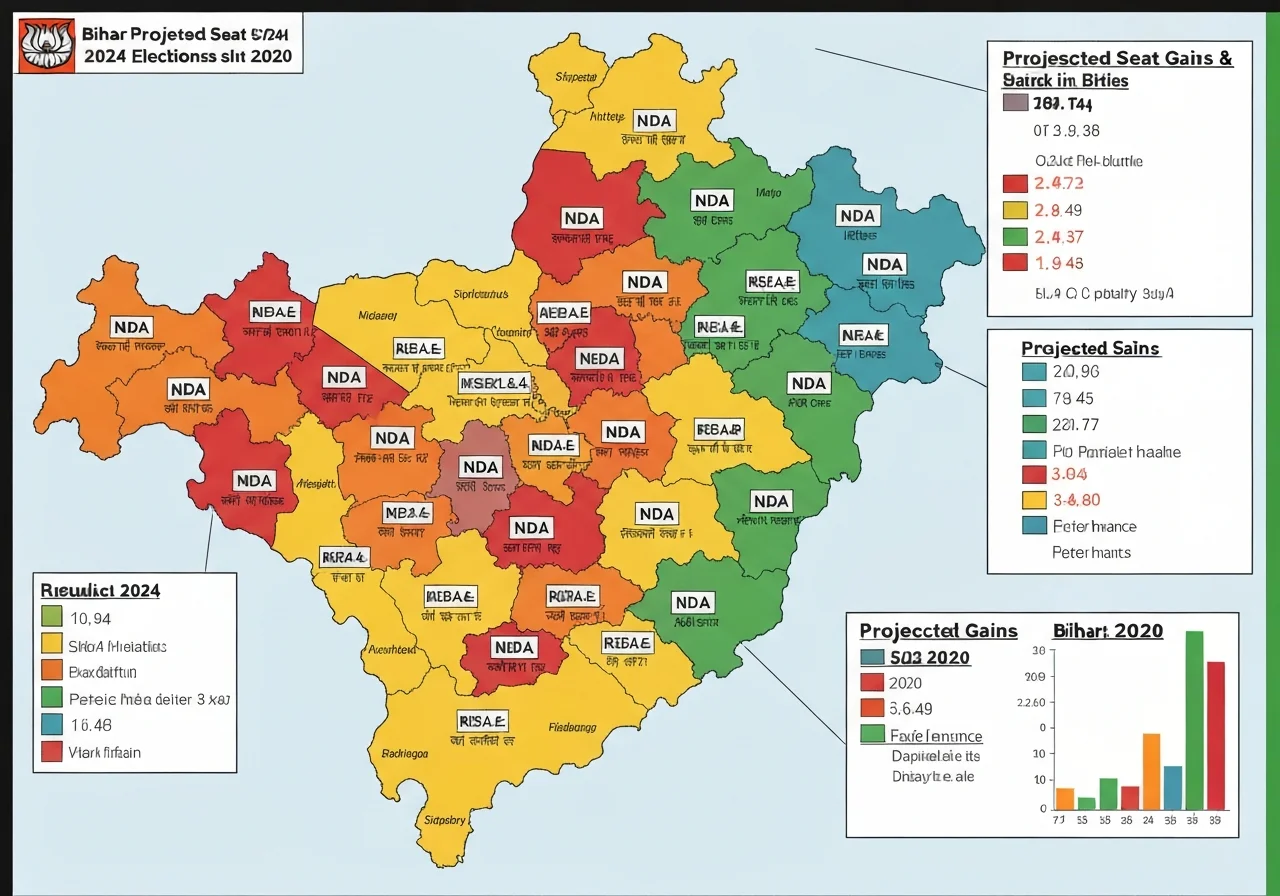
The National Democratic Alliance (NDA) appears poised for a commanding performance in Bihar's 243-seat assembly, with exit polls projecting 145-167 seats—potentially crossing the critical two-thirds majority threshold of 162 seats. The Matrize-IANS poll forecasts 147-167 seats, while Dainik Bhaskar predicts 145-160, signaling a remarkable rebound from the coalition's 125-seat tally in 2020. This resurgence mirrors NDA's 206-seat peak in 2010, suggesting revitalized voter confidence.
| Pollster | NDA Projection | Mahagathbandhan | Others |
|---|---|---|---|
| Matrize-IANS | 147-167 | 70-90 | 2-6 |
| Dainik Bhaskar | 145-160 | 73-102 | 5-10 |
| People's Pulse | 135-159 | 75-101 | 2-8 |
| People's Insight | 133-148 | 87-102 | 3-6 |
| JVC | 135-150 | 88-103 | 3-6 |
Mahagathbandhan's underperformance
The RJD-led Mahagathbandhan faces a stark reversal, projected to secure just 70-102 seats—a far cry from its 178-seat sweep in 2015 and 110 seats in 2020. As The Hindu reports, the alliance struggles to weaponize anti-incumbency against Nitish Kumar's two-decade tenure. Particularly telling is Tejashwi Yadav's diminished 58% vote share in Raghopur, a traditional bastion where his family previously commanded 70%+ support. This erosion underscores strategic miscalculations in caste coalition management.
Jan Suraaj's limited impact
Prashant Kishor's much-hyped Jan Suraaj Party (JSP) appears stillborn, with exit polls forecasting 0-3 seats statewide. DNA India's analysis reveals symbolic candidates like Piyush Priyadarshi in Mokama scraping just 2.7% support against established players. The failure to convert Kishor's reputation as a poll strategist into electoral currency exposes Bihar's rigid caste calculus—where organizational heft trumps outsider appeal. This outcome effectively preserves the state's bipolar political architecture.
Key Constituency Battles
Raghopur: Tejashwi's stronghold
The Yadav dynasty's grip on Raghopur remains ironclad, with Tejashwi Yadav projected to secure a dominant 58.02% vote share—a textbook case of legacy politics outperforming national trends. Exit polls reveal the BJP's Satish Kumar languishing at 34.35%, a 23.67-point deficit that mirrors the 2025 margin where Tejashwi trounced rivals by 66,927 votes. This isn't just a constituency battle; it's a masterclass in how political brand equity converts to electoral ROI. The RJD's localized machinery has effectively monetized Lalu Prasad's enduring influence, creating a moat around this Bihar bastion despite the NDA's statewide dominance.
Mokama: JDU's criminal-turned-politician lead
Mokama's electoral calculus defies conventional risk assessment models, with JDU's Anant Singh—a murder-accused candidate—commanding 52.72% support. The People's Insights data reveals a 378-vote lead over rivals, proving Bihar's electorate prioritizes tangible deliverables over ethical compliance. Singh's incumbency advantage and caste arithmetic have effectively hedged against his legal liabilities, while MGB's Veena Devi (38.14%) struggles to leverage her spouse's criminal legacy. This contest underscores the market inefficiency in moral hazard pricing within certain electoral segments.
MOKAMA RESULTS
| Candidate | Party | Vote Share | Key Factor |
|---|---|---|---|
| Anant Singh | JDU | 52.72% | Incumbency advantage |
| Veena Devi | MGB | 38.14% | Spouse's criminal legacy |
| Piyush Priyadarshi | Jan Suraaj | 9.14% | Youth appeal |
Tarapur: BJP deputy CM's advantage
Deputy CM Samrat Chaudhary's 56.52% projected vote share in Tarapur reflects textbook incumbency arbitrage, blending organizational strength with personal brand equity. The 22.37-point lead over RJD's Arun Kumar demonstrates how BJP has repurposed anti-incumbency sentiment against local rivals into a governance premium. This bellwether constituency's results often function as leading indicators for broader political trends, making Chaudhary's performance a critical beta measure for NDA's statewide dominance. The BJP's dual-engine strategy—leveraging both administrative track record and caste coalition management—has created an electoral blue chip in this key battleground.
Electoral Trends & Implications
Record voter turnout analysis
The 2025 Bihar Assembly elections shattered participation records, with Phase 1’s 64.69% and Phase 2’s 68.52% turnout marking the highest in 27 years (Bihar Assembly elections LIVE). This surge reflects rural mobilization around NDA’s welfare schemes, neutralizing Mahagathbandhan’s anti-incumbency push. The 4% jump from 2020 signals voters prioritized policy continuity over protest sentiment—a behavioral shift with ramifications for upcoming state elections.
Turnout Comparison
| Election Year | Phase 1 Turnout | Phase 2 Turnout |
|---|---|---|
| 2015 | 56.91% | 55.61% |
| 2020 | 53.54% | 57.05% |
| 2025 | 64.69% | 68.52% |
Nitish Kumar's enduring appeal
Exit polls confirm Kumar’s political alchemy remains potent, projecting 145-167 seats for his alliance (NDA to return in Bihar). His 20-year incumbency—interrupted only briefly—defies anti-establishment trends through caste arithmetic and "Sushasan Babu" branding. This longevity, termed a "remarkable feat" by analysts, outperforms even the 2015 opposition wave, cementing his status as Bihar’s political constant.
National implications for 2026 polls
NDA’s projected two-thirds majority recalibrates opposition strategy ahead of West Bengal and Uttar Pradesh battles (Bihar Exit Poll 2025). Prashant Kishor’s Jan Suraaj failing to secure seats demonstrates third-party viability challenges in polarized contests. The outcome signals NDA’s regained momentum in Hindi heartland politics, likely influencing 2026 campaign resource allocation.
References


Get Daily Event Alerts for Companies You Follow
Free: Register to Track Industries and Investment Opportunities