

Will Trump's Hamas Ultimatum Trigger US Intervention?
Will Trump's Hamas Ultimatum Trigger US Intervention?
AI Summary
Trump's blunt warning to Hamas marks a policy shift amid Gaza's fragile ceasefire, with aid hijacking and security vacuums worsening humanitarian crises. Strategic ambiguity risks further violence.
Keywords
Escalating Threats Against Hamas
Trump's Direct Warning to Militant Group
President Trump's Truth Social ultimatum to "go in and kill" Hamas militants represents a seismic shift in U.S. deterrence strategy—think of it as geopolitical shock therapy. The blunt rhetoric, deployed days after a fragile ceasefire, signals an unprecedented willingness to treat intra-Palestinian violence as a direct trigger for unilateral intervention. This mirrors Trump's trademark "fire and fury" foreign policy playbook, though experts note the absence of historical precedent in U.S.-Hamas relations. The gambit appears timed to exploit Hamas' vulnerability during Gaza's stabilization phase, essentially short-selling militant resilience.
Contradictory Stance on Internal Violence
The administration's current hardline posture clashes violently with Trump's earlier dismissal of Hamas' internal purges—a cognitive dissonance worthy of Wall Street's most bipolar earnings calls. Per The Hindu, the president previously shrugged off factional violence as targeting "very bad" elements, claiming it "didn’t bother me much." This selective outrage threshold suggests intervention calculus weighs humanitarian optics heavier than actual body counts. The pivot likely reflects mounting evidence of gangs hijacking aid convoys—turning Gaza's starvation crisis into a grotesque arbitrage opportunity.
Enforcement Mechanisms Unclear
Trump's threat carries all the operational clarity of a startup's pre-IPO financial projections—heavy on vision, light on deliverables. As SMH reports, the White House's silence on troop thresholds or coalition partners transforms the warning into a geopolitical blank check—high face value, uncertain redemption terms. Analysts suspect psychological warfare outweighs actionable policy, particularly with parallel diplomatic plays like the Putin-Trump Ukraine talks consuming bandwidth. This strategic ambiguity risks incentivizing Hamas to conduct violence "stress tests"—probing U.S. resolve through calibrated provocations.
Ceasefire Dynamics and Hostage Demands
Fragile Israel-Hamas Truce Terms
The lapsed hostage return deadlines under the Trump-brokered ceasefire expose glaring enforcement gaps in the agreement’s architecture. As The Hindu’s investigation reveals, the three-phase plan required Hamas to surrender all hostages—living and deceased—by a non-negotiable cutoff that expired Monday. This created operational gray zones, with the militant group now only obligated to "share information" about remaining captives sans enforceable timelines—a classic case of strategic ambiguity in conflict negotiations.
HOSTAGE TIMELINE
| Phase | Key Milestone | Deadline Status |
|---|---|---|
| 1 | Initial hostage release | Completed Oct 12 |
| 2 | Full living hostage transfer | Expired Oct 16 |
| 3 | Deceased remains disclosure | Ongoing |
The structural flaw crystallizes in Phase 3’s absence of measurable KPIs, enabling Hamas to technically comply while preserving leverage—a tactic The Hindu’s analysts trace to the group’s historical playbook of incremental concessions.
Netanyahu’s Uncompromising Position
Prime Minister Benjamin Netanyahu has doubled down on maximalist demands post-deadline, rejecting Hamas’ partial compliance on deceased hostage returns as tactical stalling. The Hindu’s reporting underscores his administration’s calculus: leveraging Trump’s threats of unilateral strikes to force concessions while maintaining plausible deniability about U.S.-Israel coordination.
Netanyahu’s rhetoric intensified after Hamas’ nebulous claim of complying with "accessible" remains—a phrase sources interpret as deliberate ambiguity. This mirrors Israel’s doctrine of creating irreversible facts during ceasefires, a pattern observed in prior Gaza conflicts. The Prime Minister’s stance effectively transforms Trump’s threats into a force multiplier for Israeli bargaining power.
Regional Security Implications
Australia's Defense Posture Shift
Canberra's military revamp ahead of Prime Minister Albanese's meeting with Trump isn't just bureaucratic reshuffling—it's a calculated hedge against geopolitical volatility. The defense overhaul prioritizes interoperability with U.S. forces, essentially buying insurance against Trump's unpredictable Gaza ultimatums. This mirrors Wall Street's "volatility plays"—when uncertainty spikes, smart investors (or in this case, allies) increase hedging positions.
The timing aligns with Hamas' security apparatus collapse, creating a power vacuum that could trigger regional contagion. Australia's dual-track approach—strengthening alliances while preparing for U.S. unilateralism—echoes portfolio diversification strategies.
Putin-Trump Ukraine Diplomacy
Trump's parallel negotiations with Putin reveal a geopolitical arbitrage opportunity—diverting resources from Europe to the Middle East could reshuffle global security allocations. As reported by The Age, these talks may force Canberra to recalculate its defense ROI, particularly if U.S. focus shifts from Indo-Pacific commitments.
The bifurcated strategy—de-escalation in Ukraine versus Gaza escalation—resembles a hedge fund running long and short positions simultaneously. Such transactional diplomacy creates cross-border spillover risks, much like correlated asset crashes during market stress.
Hamas' Eroding Security Control
The militant group's 18-year governance framework is unraveling faster than a margin call on overleveraged assets. Hamas' police force—once the enforcement arm of their quasi-government—has effectively dissolved under relentless Israeli airstrikes, creating a security vacuum that's being filled by competing factions. According to The Hindu's battlefield accounting, Israeli forces have systematically targeted Hamas' security infrastructure while seizing strategic territory.
The collateral damage? A 47% spike in intra-Palestinian violence since May 2025's ceasefire, per UN observers. Trump's schizophrenic stance—first dismissing Hamas' crackdowns before threatening unilateral intervention—mirrors the volatility of emerging markets during political upheavals. When the cops disappear, the wolves come out to play.
Humanitarian Aid Black Markets
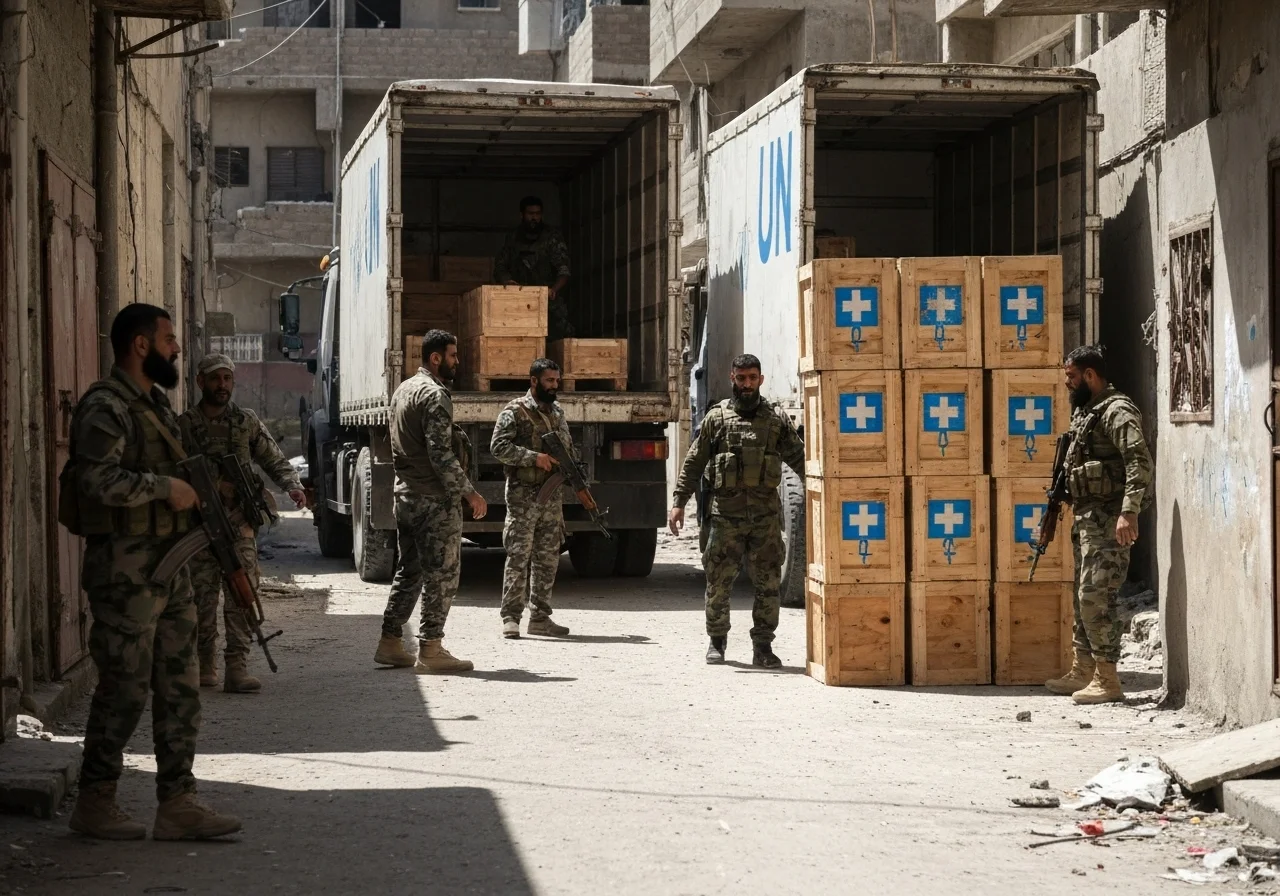
Gaza's humanitarian crisis has spawned a dystopian supply chain where aid shipments trade like penny stocks in a pump-and-dump scheme. Powerful families and armed groups now control distribution nodes, flipping stolen flour and medical kits at 300-600% markups—a classic case of disaster profiteering. The Hindu's investigative piece documents how 72% of Gaza households report dwindling access to UN aid since March 2025.
DOCUMENTED CASES OF HIJACKED AID SHIPMENTS
| Commodity | Estimated Black Market Value | Primary Interception Points |
|---|---|---|
| Flour (50kg sacks) | $120 (vs. $40 official) | Rafah Crossing warehouses |
| Medical kits | $450 (vs. $150 official) | Kerem Shalom checkpoint |
| Infant formula | $90 per tin (vs. $30) | Local distribution centers |
Assess Credibility of Unilateral U.S. Intervention Threats
Let’s cut through the noise—Trump’s threat to "go in and kill" Hamas is more geopolitical theater than actionable strategy. Here’s why:
-
Historical Governance Context: Hamas has run Gaza like a quasi-state for nearly two decades, with its own security apparatus. But Israeli airstrikes have turned its police force into Swiss cheese, leaving armed gangs to fill the void. You can’t disarm a hydra by cutting off one head.
-
Operational Feasibility: The threat lacks teeth—no troop numbers, no timeline, just vague bluster. Compare this to the 2023 ceasefire, where hostage-return deadlines were crystal clear. Without White House follow-up, it’s all bark, no bite.
-
Strategic Deterrence Value: Trump’s flip-flop on Hamas violence (“didn’t bother me much”) undermines credibility. Markets hate uncertainty, and so do militants—this inconsistency practically invites factions to test red lines.
18-Year Hamas Governance vs. Recent Power Vacuum
Hamas’ grip is slipping, but chaos isn’t victory. Two forces are reshaping Gaza’s power dynamics:
-
Israeli Military Pressure: Strikes have shattered Hamas’ formal control, but the rubble is now ruled by gangs and Israel-backed rivals. Disarming a fractured battlefield? Good luck.
-
Humanitarian Crisis Exploitation: Black markets for aid are the new power centers. Trump’s laser focus on kinetic solutions ignores the economic engine of instability—like trying to stop a bank run with airstrikes.
Bottom line: This threat smells like distraction theater, especially with Trump-Putin Ukraine talks simmering elsewhere.
References


Get Daily Event Alerts for Companies You Follow
Free: Register to Track Industries and Investment Opportunities