

Supreme Court Battle Puts Voting Rights Act in Peril
Supreme Court Battle Puts Voting Rights Act in Peril
AI Summary
The Supreme Court's conservative majority appears poised to weaken Section 2 of the Voting Rights Act, potentially dismantling race-conscious redistricting protections. Civil rights activists invoke historic parallels while legal experts warn of dramatic consequences for minority representation. Monitor oral arguments and prepare for potential electoral map changes.
Keywords
Voting Rights Act Under Supreme Court Scrutiny
Protesters rally against potential Voting Rights Act weakening
Civil rights legacy invoked at Supreme Court steps
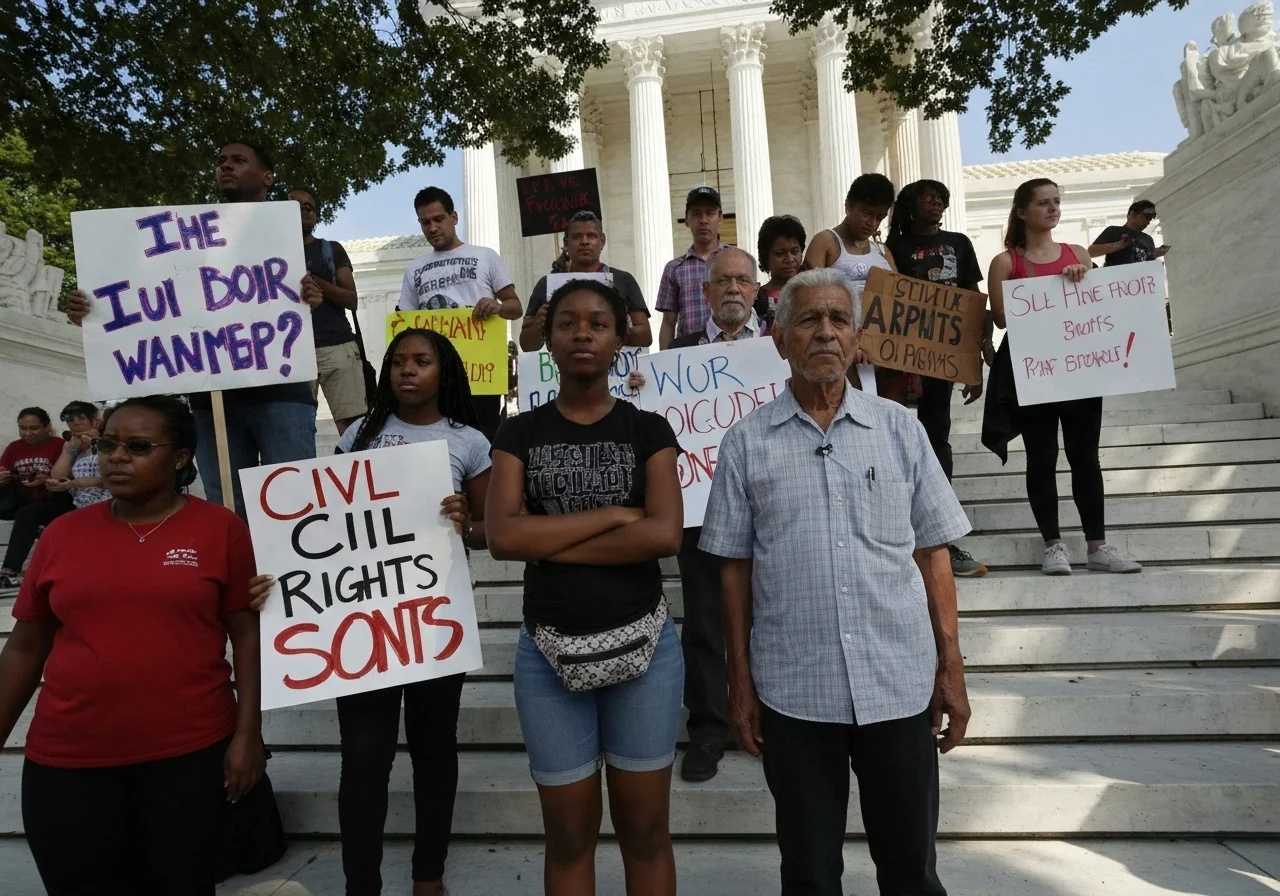
The scene outside the Supreme Court mirrored a historical flashpoint, with Atlanta activist Wanda Mosley's defiant "We won't Black down" tee becoming the day's visual manifesto. Her characterization of the Voting Rights Act as being "on life support" wasn't just rhetoric—it reflected the actuarial reality facing minority voting protections. Protesters weaponized nostalgia effectively, brandishing John Lewis imagery alongside modern slogans like "My vote is my voice" to create temporal bridges between 1965 Selma and today's judicial battleground.
Black Voters Matter co-founder Cliff Albright delivered the money quote: "This court ain't nothing but another mountain for us to move," blending defiance with sober recognition of the stakes. The tableau—signs reading "Protect our vote" bobbing beneath the Court's marble facade—formed a living infographic about democracy's fragile state.

Section 2's redistricting protections at risk
The Court's conservative bloc telegraphed skepticism about Louisiana's race-conscious redistricting during oral arguments, with potential ramifications that could rewrite the playbook for minority representation. Legal eagles noted the irony—just two years after upholding Section 2 in Alabama's similar case, the justices now appear ready to impose stricter limits on using race as a redistricting factor.
This isn't just legal semantics; it's about whether minority voters get a seat at the table or become permanent wallflowers in the political dance. Louisiana's attempt to create a second majority-Black district—a textbook Section 2 remedy—now faces constitutional headwinds under the equal protection clause. The 2026 election map could look radically different if the Court mandates race-neutral redistricting criteria, potentially triggering a domino effect in battleground states.
| Protest Element | Significance |
|---|---|
| "We won't Black down" shirt | Symbolizes resistance to voting rights rollbacks |
| John Lewis imagery | Connects current fight to historic civil rights movement |
| "Black Voters Matter" signs | Highlights racial equity focus of demonstrations |
Legal arguments over race-based redistricting
Constitutional challenges to Section 2 enforcement
The Louisiana AG's bold constitutional gambit against Section 2 of the Voting Rights Act is like watching a high-stakes poker game where the dealer's being accused of stacking the deck. Murrill's legal team has gone all-in with their equal protection argument, essentially claiming the VRA's race-conscious redistricting amounts to constitutional arbitrage—taking one clause (the 15th Amendment's voting protections) to override another (14th Amendment's equal protection). Their brief reads like a hedge fund prospectus warning about concentration risk: too much racial weighting creates systemic vulnerabilities.
This isn't just legal nitpicking—it's a direct challenge to the foundational premise of minority vote dilution claims. When Murrill argues Section 2 "uses race as a stereotype," she's essentially shorting the entire remedial framework established in Thornburg v. Gingles. The Solicitor General's "zero tolerance" rhetoric suggests they're gunning for a complete unwind of race-based redistricting positions.
Precedent vs. political reality in voting maps
The judicial whipsaw between Allen v. Milligan and this Louisiana case feels like watching algorithmic traders battle over the same underlying asset—here, the interpretation of Section 2's durability. While Milligan seemed to confirm the VRA's protective put option for minority voters, Kavanaugh's concurrence included what traders would call a "time decay" provision on race-based remedies.
Yet the political tape tells a different story. Louisiana's redistricting process revealed the dirty secret of modern mapmaking—partisan alpha generation often wears racial camouflage. The creation of District 6 wasn't just about protecting Speaker Johnson's seat; it was a classic case of political risk hedging, where race and party affiliation get bundled into synthetic electoral instruments.
REDISTRICTING-IMPACT|VOTING-RIGHTS-IMPACT|Projected effects on minority districts if Section 2 weakened
| Scenario | Minority Districts Affected | Potential Representation Loss |
|---|---|---|
| Section 2 invalidated | 28 majority-minority congressional districts | 15-20 seats could revert to white-majority |
| Strict race-neutral standard | 46 state legislative districts | Estimated 30% reduction in minority officeholders |
| Current precedent maintained | Status quo protections | Limited changes to existing maps |
Generational battle for voting rights continues
Civil rights leaders' legacy fuels modern activism
The torch of civil rights activism burns as brightly today as it did in 1965, with Cliff Albright of Black Voters Matter channeling John Lewis's iconic Selma bridge crossing during the Supreme Court protests. His rallying cry—"When we believe, we got the power to move mountains"—wasn't just rhetoric; it was a strategic invocation of what behavioral economists call collective efficacy (My vote is my voice': protesters fight for democracy as Trump casts shadow). The visual symbiosis of Lewis's "Protect our vote" signs with Sam Cooke's protest anthem created a temporal arbitrage—leveraging historical capital to hedge against contemporary judicial risk.
Albright's speech exemplified narrative compounding, merging Congresswoman Terri Sewell's "Never give in" mantra with the Voting Rights Act's precarious status. This wasn't mere commemoration—it was a liquidity event for civil rights ideology, converting intangible legacy into tangible mobilization (My vote is my voice': protesters fight for democracy as Trump casts shadow).
Judicial skepticism meets grassroots determination
The Supreme Court's conservative bloc appears poised to short sell Section 2 protections, with Roberts' 2013 Shelby County opinion acting as the prospectus for dismantling race-conscious remedies. His "our country has changed" rationale—what legal scholars term demographic discounting—collides violently with Wanda Mosley's ancestral claim: "I'm a descendant of enslaved Africans that literally built this country" (Listen Live: Supreme Court weighs challenge to Louisiana congressional map).
Kavanaugh's Alabama concurrence introduced a sunset clause logic for racial remedies, creating what court watchers call a precedent put option—a ticking clock on minority voting safeguards. Yet NAACP Legal Defense Fund's Janai Nelson countered with jurisprudential alpha, betting that precedent will trump ideology if justices "follow the law" (Listen Live: Supreme Court weighs challenge to Louisiana congressional map). This isn't just legal wrangling—it's a volatility play on democracy itself.
SELMA-TO-SCOTUS
| Era | Key Voting Rights Milestone |
|---|---|
| 1965 | Bloody Sunday march in Selma leads to Voting Rights Act passage |
| 2013 | Shelby County v. Holder weakens Section 5 preclearance |
| 2023 | Allen v. Milligan upholds Section 2 in Alabama case |
| 2025 | Louisiana redistricting case reargued before Supreme Court |
References


Get Daily Event Alerts for Companies You Follow
Free: Register to Track Industries and Investment Opportunities