

Will SNAP Funding Survive the Shutdown? Courts Force Partial Relief
Will SNAP Funding Survive the Shutdown? Courts Force Partial Relief
AI Summary
Judicial rulings compel Trump administration to release $5.5B in SNAP contingency funds during shutdown, exposing systemic vulnerabilities in food assistance programs while millions face benefit reductions.
Keywords
Judicial Intervention Forces Partial Relief
Federal judges mandate contingency fund usage
The courts just dropped the hammer—Massachusetts and Rhode Island federal judges delivered a one-two punch, forcing the Trump administration to tap into $5.5 billion in SNAP contingency funds during the government shutdown. Judge Indira Talwani didn’t mince words, ruling the benefit suspension outright unlawful and ordering the USDA to either partially fund November benefits using emergency reserves or go all-in by combining contingency funds with other resources. Meanwhile, Judge John J. McConnell Jr. in Rhode Island slapped down the administration’s narrow interpretation of contingency funds, insisting existing work requirement waivers stay intact.
This judicial lifeline came after the USDA pulled a classic midnight move—yanking its contingency plan from official websites in early October and replacing it with finger-pointing at congressional Democrats. As Japan Today reported, the rulings set a hard Monday deadline for the administration to show its cards: full payments required same-day execution, while partial payments bought them until Wednesday.
| Funding Scenario | Legal Basis | Beneficiary Impact |
|---|---|---|
| Full funding ($8B/month) | Contingency funds + tariff revenue | No interruption in benefits |
| Partial funding ($5.5B) | Contingency funds only | 50% benefit reduction |
| No funding | Shutdown justification | Complete benefit suspension |
Administration opts for minimal compliance
Talk about half-measures—despite having a $23 billion reserve at their fingertips, the administration chose to do the bare minimum, releasing only the court-mandated $5.5 billion. The result? Pure chaos. States scrambled for weeks to reconfigure electronic benefit transfer systems for prorated payments, with Treasury Secretary Scott Bessent admitting funds might not hit accounts until mid-November due to processing logjams.
The contrast couldn’t be starker—while military payrolls and immigration enforcement got fast-tracked during the shutdown, SNAP recipients were left twisting in the wind. As NY Mag’s analysis laid bare, this calculated move let Republicans keep the heat on Democrats while squeezing vulnerable families. USDA’s own court filings warned states could take "weeks or even months" to recalculate benefits, leaving millions in the dark about their next meal.
Impact on Vulnerable Populations
42 million Americans face benefit uncertainty
Let’s cut through the noise—when the USDA pulled its October contingency plan without warning, it left 42 million SNAP recipients holding the bag during peak holiday demand. The $5.5 billion stopgap sounds substantial until you realize it translates to a threadbare $190 per person monthly—now further diluted by recalculated payments. Food banks are getting hammered with 200% demand spikes, while EBT systems creak under operational chaos. The administration’s messaging blames congressional Democrats, but the AP’s documentation of Rhode Island’s 25% benefit band-aid reveals the real fragility here.
Disproportionate effect on children and veterans
Here’s where the rubber meets the road: two-thirds of SNAP households have kids under 18, meaning nutritional shortfalls hit during critical developmental windows. The administration doubled down by axing work requirement waivers for veterans mid-shutdown—a move so tone-deaf even Judge McConnell reversed it. These populations face brutal trade-offs: kids lose school meal bridges, while veterans juggle disability claims against grocery budgets.
SNAP_DEMOGRAPHICS
<div data-table-slug="snap-demographics">| Demographic | Percentage | Key Vulnerability |
|---|---|---|
| Families with children | 67% | School meal dependency |
| Employed adults | 44% | Low-wage worker precarity |
| Veterans/disabled | 12% | Medical cost trade-offs |
| Elderly (60+) | 9% | Fixed income constraints |

The $23 billion reserve sitting unused isn’t just fiscal conservatism—it’s systemic neglect. Urban food deserts see triple-digit emergency request surges, while rural counties lack distribution infrastructure entirely. This isn’t red vs. blue—it’s 86% high-participation districts (including Trump’s Appalachian base) taking identical hits.
Political and Operational Fallout
Partisan battle over safety net priorities
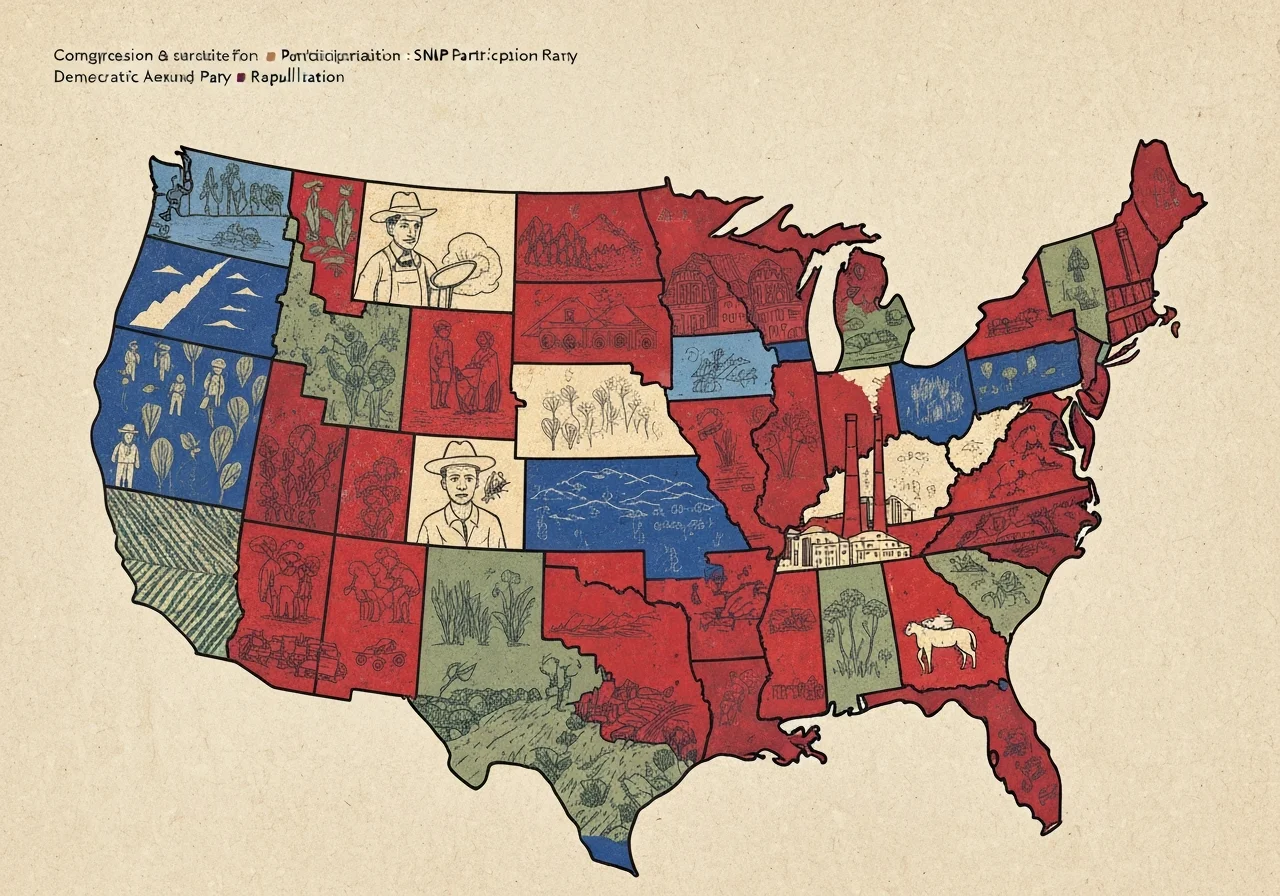
Let’s cut through the political theater—this SNAP funding crisis has become a proxy war over America’s social contract. The numbers don’t lie: 43 of the 50 congressional districts with the highest SNAP participation are Democratic strongholds (New York Magazine). Meanwhile, GOP lawmakers are playing 4D chess, using the shutdown to ram through work requirement reforms that could boot 2.4 million people off the rolls—per CBO estimates.
The administration’s selective funding approach reeks of political calculus. They’ll move heaven and earth to keep military paychecks flowing, but nutrition assistance? That takes a federal judge’s order. As Vox put it, we’re seeing "extraordinary measures" for pet projects versus bare-minimum compliance for everything else.
State-level contingency plans diverge
When the federal spigot runs dry, state capitals reveal their true colors. California and New York? They’re digging into rainy-day funds like Wall Street traders during a market crash. But down South, outdated EBT systems are buckling under the strain—CBS News reports it takes weeks to reconfigure these digital dinosaurs for partial payments.
The patchwork response would be comical if it weren’t so tragic. Rhode Island’s scraping together 25% benefits for TANF recipients, while Delaware’s basically telling folks "don’t call us, we’ll call you"—November 7th, maybe. The Guardian’s documentation of this chaos exposes how federal-state dysfunction turns hunger into a zip code lottery.

Safety Net Vulnerability in Budget Standoffs
Systemic fragility of automatic stabilizers
The 34-day government shutdown ripped the Band-Aid off SNAP's contingency funding design flaws—turns out these automatic stabilizers were built for hurricanes, not political hurricanes. As The Guardian's coverage revealed, that $5.5 billion emergency reserve got stretched thinner than a day trader's margin when forced to cover just 50% of November benefits. This single-point failure mirrors the Achilles' heel in other stabilizers like unemployment insurance, where political brinksmanship can override economic safeguards faster than a circuit breaker halts a market crash. The Japan Today analysis showed states needed two full weeks to reconfigure EBT systems—proof that centralized administration creates bottlenecks tighter than a Fed rate hike.
Long-term trust erosion in federal programs
When the benefit spigot runs dry, participation rates tank—Vox's deep dive projects a chilling 19% Medicaid dropout rate among dual-eligible SNAP households. Now states are building parallel safety nets like hedge funds diversifying against systemic risk, with California and New York deploying emergency funds while Southern states drag their feet. As NY Mag's analysis notes, this Balkanization accelerates as Congressional Republicans push work requirement reforms that would shift costs to states faster than hot money flees emerging markets. The operational chaos—Rhode Island cutting checks within days while Delaware projected November 7th timelines—is eroding confidence in federal programs like a bear market eats away at retirement accounts.
TABLE_NAME
| State | Emergency Funding Allocated | Benefit Distribution Timeline | Work Requirement Waivers Maintained |
|---|---|---|---|
| California | $200 million | November 5 | Yes |
| New York | $175 million | November 6 | Yes |
| Texas | $85 million | November 12 | No |
| Rhode Island | $4.2 million | November 3 | Yes |
| Alabama | No state funds | November 15 | No |
References


Get Daily Event Alerts for Companies You Follow
Free: Register to Track Industries and Investment Opportunities