

Why Is Nvidia Dominating AI? $57B Quarter Reveals All
Why Is Nvidia Dominating AI? $57B Quarter Reveals All
AI Summary
Nvidia's 66% YoY data center GPU growth to $51.2B signals irreversible industry shift to accelerated computing, with Blackwell chips sold out through 2026. Investors should monitor cloud providers' 100% GPU utilization rates.
Keywords
Surging demand drives record earnings
AI chip sales exceed market expectations
Nvidia just dropped a mic with its fiscal Q3 2025 results—$57 billion in revenue representing a jaw-dropping 62% year-over-year surge that left analysts scrambling to update their models. The real showstopper? Data center GPUs raking in $51.2 billion (a 66% annual jump), proving hyperscalers are drinking from the AI firehose like there's no tomorrow. CEO Jensen Huang's quip about Blackwell architecture sales being "off the charts" wasn't corporate fluff—Fortune's deep dive reveals cloud providers are burning through inventory faster than Nvidia can fab these chips. This isn't just growth; it's the wholesale replacement of CPU dinosaurs with GPU-powered rocketships, with Nvidia commanding a staggering 80%+ stranglehold on data center AI silicon.
TABLE_NAME
<div data-table-slug="nvidia-q3-2025-performance">| Revenue Segment | Q3 2025 ($B) | YoY Growth |
|---|---|---|
| Data Center GPUs | 51.2 | 66% |
| Gaming | 3.1 | 15% |
| Professional Visualization | 1.8 | 9% |
| Automotive | 0.9 | 5% |
Upward guidance surprises Wall Street
When Nvidia whispers, Wall Street jumps—and this quarter's $65 billion Q4 forecast (a cool $3 billion above consensus) sent shockwaves through trading floors. CFO Colette Kress dropped the truth bomb that cloud providers are running GPUs at 100% utilization, with the Business Insider analysis projecting AI infrastructure spending will balloon to $4 trillion by 2030. Huang's earnings call revelation about "three massive platform shifts" in AI wasn't just visionary—it's the playbook every tech CEO wishes they'd written. Even with China revenue kneecapped by export controls, that 14% sequential growth projection tells you everything about how global enterprises are betting big on AI. As Wedbush's Dan Ives put it in his sector commentary, this was the moment the Street stopped worrying and learned to love the AI boom.
Transition from CPUs to accelerated computing
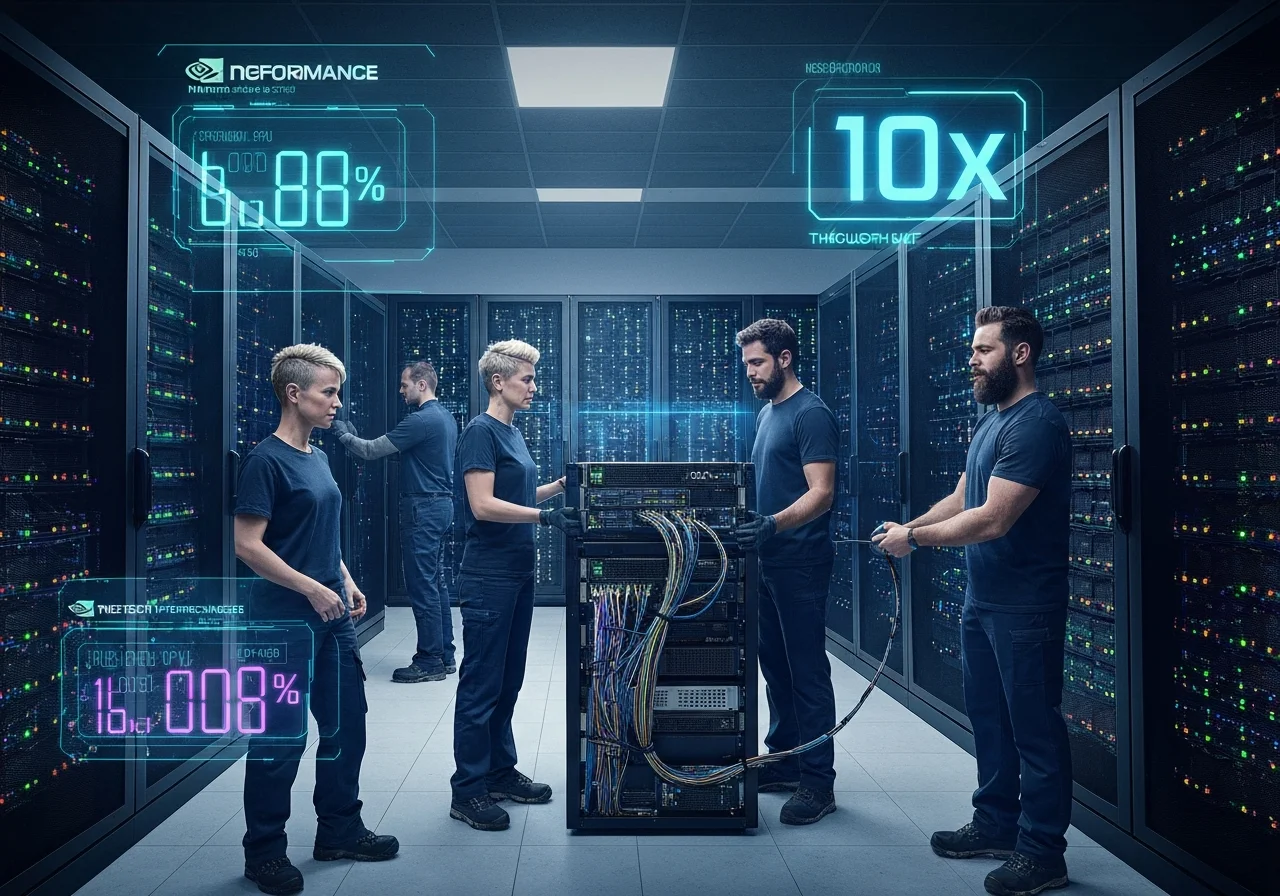
The death of Moore's Law isn't just a technical footnote—it's the starting gun for Nvidia's dominance. As Jensen Huang bluntly put it, we've hit the "end of the CPU roadmap," forcing every data center to embrace GPU acceleration. Nvidia's 20-year head start in parallel processing isn't just paying off—it's creating an insurmountable moat. Their CUDA platform has become the de facto operating system for AI, locking in developers tighter than Wall Street's grip on quarterly earnings.
The numbers tell the story: $51.2 billion in data center GPU revenue last quarter alone, up 66% YoY. That's not just growth—it's a wholesale industry shift. Competitors are left playing catch-up while Nvidia's full-stack approach (hardware + software + ecosystem) keeps widening the gap.
Generative AI's enterprise adoption
Forget the hype—generative AI is now moving the needle where it counts: the bottom line. Meta and Alphabet are seeing double-digit jumps in ad revenue thanks to Nvidia-powered recommendation engines solving what Huang calls the "tiny screen problem". Content moderation—once a money pit—is now delivering 40-60% efficiency gains.
This isn't academic anymore. When Wedbush's Dan Ives talks about a "virtuous cycle," he means real dollars: every 1% improvement in ad targeting justifies another $100M in GPU purchases. No wonder Blackwell chips are sold out through 2026—cloud providers are running these things at 100% utilization.
Agentic AI's emerging potential
Here's where things get sci-fi: AI that doesn't just recommend videos but rewrites its own code. Nvidia's partnerships with OpenAI aren't about chatbots—they're building the nervous system for autonomous factories. Early adopters are already slashing downtime by 30-50% using Nvidia's edge AI for predictive maintenance.
Huang's "physical AI" vision extends beyond servers—Tesla's robots and autonomous vehicles run on the same architecture. With the market projected at $1.2T by 2030, Nvidia isn't just riding the wave—they're the ocean.
Geopolitical and market considerations
China market challenges persist
The Middle Kingdom's great firewall now extends to silicon, with Nvidia's H-20 GPU sales cratering to a mere $50 million last quarter—chump change for a company raking in billions elsewhere. U.S. export controls have effectively handed China's domestic players like Huawei a golden opportunity to fill the void. CFO Colette Kress's admission that "sizable purchase orders never materialized" speaks volumes about Beijing's determination to decouple. The real kicker? Nvidia's guidance now assumes zero China revenue—a stunning reversal for what was once its third-largest market.
Investor confidence in AI longevity
Wall Street's verdict is clear: the AI trade has legs. Despite Michael Burry's bearish bets, Nvidia's $65 billion Q4 forecast sent semiconductor stocks soaring 5-7% after hours. The divergence between skeptics and reality reflects a fundamental truth—today's AI infrastructure buildout mirrors the early internet's physical layer expansion. As Evercore ISI analysts noted, hyperscalers are running GPUs at full tilt, not gathering dust like 1999's fiber-optic cables. This isn't speculative mania—it's the industrial revolution 4.0 playing out in real-time.
MARKET-REACTION
| Company | After-Hours Movement | Sector Influence |
|---|---|---|
| Nvidia (NVDA) | +5.2% | AI Infrastructure |
| Broadcom (AVGO) | +7.1% | Semiconductor |
| AMD (AMD) | +6.4% | GPU Competitor |
| Oracle (ORCL) | +5.3% | Cloud Services |
Ecosystem expansion across industries and geographies
The AI gold rush is real, folks—Nvidia’s ecosystem is scaling faster than a hyperscaler’s data center. With Blackwell GPU sales described as "off the charts", the company’s reach now spans healthcare, automotive, and beyond. CEO Jensen Huang’s earnings call revelation about "more new foundation model makers, more AI startups, across more industries, and in more countries" isn’t just corporate fluff—it’s a tectonic shift in AI adoption.
The proof? Look no further than Nvidia’s data center segment, which ballooned 66% YoY to $51.2 billion. Strategic alliances with OpenAI and Anthropic aren’t just PR wins—they’re gigawatt-scale commitments that cement Nvidia’s pole position in the AI infrastructure race.
Hardware-software synergy creating competitive moat
Let’s talk about Nvidia’s "unfair advantage"—their 20-year head start with CUDA architecture. While rivals scramble to replicate their hardware-software integration, Nvidia’s already running the AI marathon at sprint speeds. This isn’t just about GPUs—it’s about dominating every phase of AI, from training to inference, thanks to a software moat thicker than Warren Buffett’s margin of safety.
The death of Moore’s Law, as highlighted in this Fortune analysis, plays right into Nvidia’s hands. Huang’s "singular architecture" pitch isn’t marketing—it’s physics. When classical computing hits a wall, accelerated computing becomes the only exit ramp.
Investment cycle shows no near-term slowdown signs
Bubble talk? Not in Nvidia’s earnings call. Their $65 billion Q4 guidance—$3 billion above estimates—reads like a middle finger to the bears. CFO Colette Kress’s $3-4 trillion AI infrastructure projection by 2030 isn’t pie-in-the-sky—it’s grounded in the reality of cloud providers maxing out GPU capacity.
Huang’s right—we’re witnessing three platform shifts converging like tectonic plates. And just like earthquakes, they’ll reshape the landscape whether skeptics like it or not. Capacity constraints today mean demand isn’t softening—it’s straining against the limits of physics. That’s not a bubble—that’s a bottleneck.
References


Get Daily Event Alerts for Companies You Follow
Free: Register to Track Industries and Investment Opportunities