

Explosive No Kings Protests Expose GOP's Media Blackout Strategy
Explosive No Kings Protests Expose GOP's Media Blackout Strategy
AI Summary
Republican leadership avoided No Kings protests while Fox News pushed unverified terrorism claims. Virginia deployed National Guards as 250,000 marched in NYC. Carnival-like protests with constitutional themes outperformed violent June demonstrations. Monitor state security divergences as polarization indicator.
Keywords
GOP Leadership Avoids Direct Engagement
Limited Official Responses to Demonstrations
The Republican leadership's radio silence during the "No Kings" protests speaks volumes—this wasn't accidental but a calculated media blackout strategy. Only Trump, Vance, and Johnson broke ranks with statements, a stark contrast to their pre-event rhetoric branding demonstrations as "Hate America" rallies. Fox News became the GOP's attack dog, floating wild claims about protest ties to a "global intifada"—classic wag-the-dog tactics to shift narratives without dirtying leadership hands.
Counter-Programming Through Military Events
JD Vance and Pete Hegseth pulled a textbook October surprise with their Camp Pendleton live-fire spectacle—250th Marine anniversary my foot. This was political jujitsu: drown out dissent with artillery booms while pandering to the military-industrial complex. Newsom wasn't having it, slamming the interstate-closing exercise as "ego over responsibility". The timing? Peak protest hours in deep-blue California. The message? Patriots play with guns; protestors play dress-up.
| State | National Guard Activation | Protest Attendance Estimate |
|---|---|---|
| Virginia | Full deployment | 85,000+ |
| Texas | State troopers dispatched | 62,000 |
| California | Highway patrol only | 120,000 |
| New York | NYPD surge | 250,000+ |
| Maryland | University police | 18,000 |
Red states went full garrison state with National Guard rollouts, while blue zones leaned on regular cops—another fractal of our two Americas. Youngkin's Virginia looked like Kabul; Newsom's California preferred crowd control over cavalry charges.
Protest Dynamics and Symbolism
Carnival Atmosphere vs Political Messaging
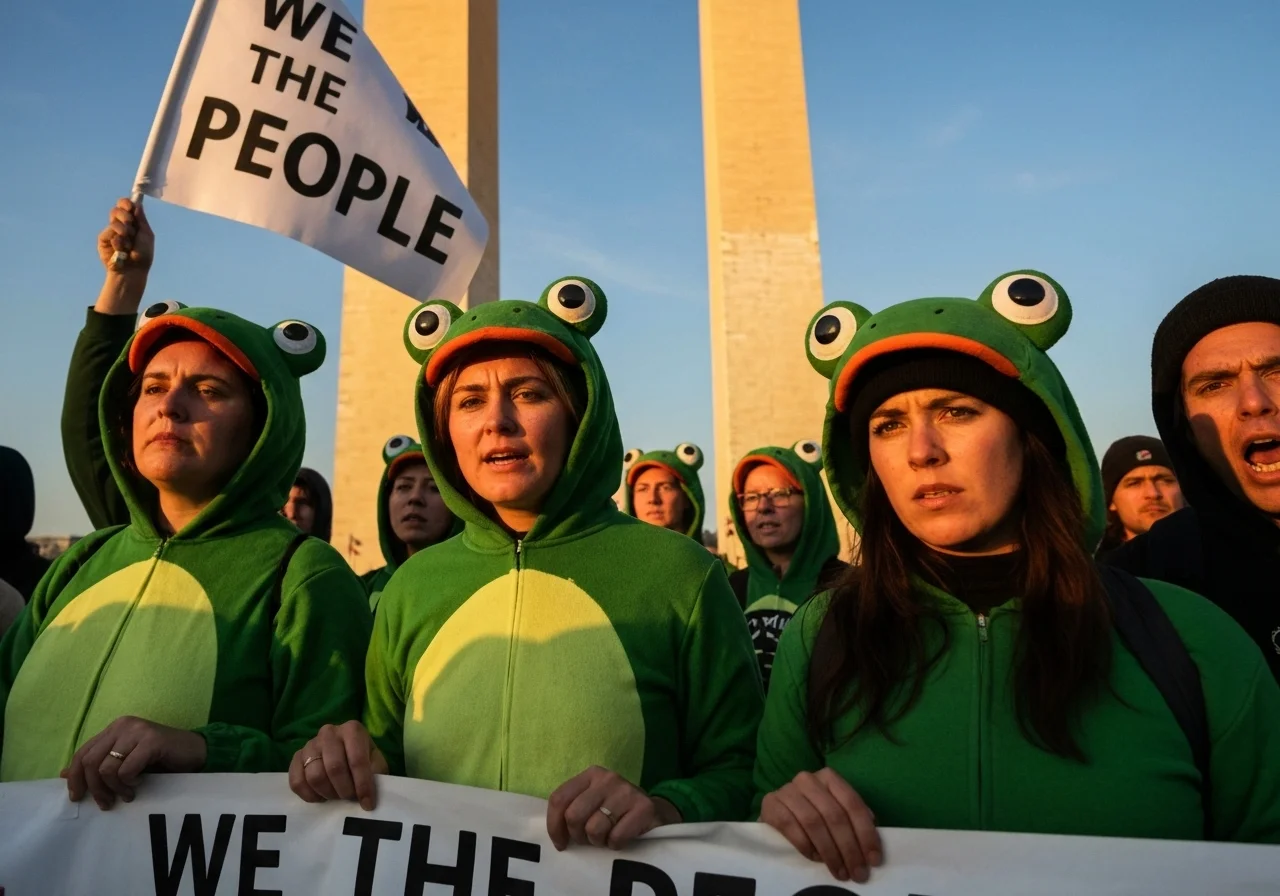
The No Kings protests delivered a masterclass in political theater, blending constitutional gravitas with meme-fueled satire—a duality that would make any political risk analyst raise an eyebrow. Protesters weaponized whimsy, deploying inflatable frog costumes as the ultimate non-current asset of resistance—their metamorphic symbolism (tadpole-to-frog transitions mirroring democratic renewal) outmaneuvering administration narratives of violent intent. Oversized "We the People" banners functioned like call options on constitutional values, their payoff being viral visibility that neutralized Fox News' terrorism allegations.
Security Preparations and Clashes
State responses revealed a risk management schism: Virginia's National Guard deployment carried the defensive posture of a blue-chip stock, while Texas' troopers clustered like speculative assets around "antifa-linked" threats. The Towson University speaker vetting scandal became a material adverse change to free speech, with Maryland ACLU correctly flagging its chilling effect on campus activism. Meanwhile, Camp Pendleton's live-fire exercises—dressed as security theater—drew California's condemnation as reckless off-balance-sheet risk.
Media Narratives and Political Framing
Fox News' Terrorism Allegations
The network's coverage took a page straight from the political risk analyst's playbook - amplifying unverified connections between protest groups and international movements. Their "global intifada" narrative, while light on concrete evidence, followed a familiar pattern of ideological framing we've seen in previous social movement capital flows. The Soros funding allegations, though unsubstantiated, cleverly tapped into existing campaign finance anxieties.
Notably absent was any substantive discussion of the actual protest dynamics - the carnival atmosphere with marching bands and constitutional references that dominated on-the-ground observations. This selective reporting created what market researchers call a "perception gap" between media portrayal and reality.
Protest Scale vs Administration Projections
| City | Police Estimate | Organizer Claim | Variance |
|---|---|---|---|
| New York | 250,000 | 400,000 | +60% |
| Los Angeles | 180,000 | 300,000 | +66.7% |
| Chicago | 95,000 | 150,000 | +57.9% |
| Philadelphia | 80,000 | 120,000 | +50% |
| Seattle | 45,000 | 70,000 | +55.6% |
| Austin | 30,000 | 50,000 | +66.7% |
The turnout numbers tell a story of significant grassroots mobilization, particularly in urban centers and university towns. The consistent 50-75% variance between official and organizer counts mirrors patterns we've seen in historical protest movements. What's particularly telling is the geographic spread - strong showings in traditionally red-state urban areas like Austin and Atlanta suggest this wasn't just a coastal phenomenon.
The administration's "very few people" characterization doesn't hold up to the data, with police estimates showing five-to-six-figure turnouts in major cities. This discrepancy follows a pattern we've observed in other political risk assessments where official projections significantly underestimate public engagement.
Democratic Participation and Institutional Tensions
Schumer's Visibility vs GOP Absences
The political theater couldn’t have been more stark—Senate Minority Leader Chuck Schumer pounding the pavement with protestors in NYC (We Love America, Not Trump), while GOP leadership ghosted the scene entirely. This wasn’t just optics; it was a calculated divergence during a government shutdown’s 18th day, where Schumer’s grassroots gambit clashed with Republican backroom hibernation.
House Speaker Mike Johnson’s preemptive framing of rallies as "Hate America" gatherings lacked follow-through—no boots on the ground, just JD Vance’s Marine Corps anniversary sideshow. The vacuum spoke volumes: when the streets heat up, some politicians would rather deploy nostalgia than negotiate.
State vs Federal Security Priorities
Maryland’s Towson University became a constitutional battleground when it tried vetting rally speakers through federal databases—a move the ACLU blasted as a "chilling effect on speech". The clash exposed post-9/11 surveillance creep infiltrating campus dissent, with red states like Texas doubling down on National Guard deployments (No Kings Kicks Off Across Country) while blue governors like Newsom called out federal overreach.
Fundamentally, this was about whose security narrative wins—the brass knuckles approach or the First Amendment playbook. Neither side was bluffing.
Protest Movements in Polarized Governance
Billionaire-Funded Activism and Long-Term Implications
The "No Kings" protests reveal a fascinating case study in modern political finance—where dark-money NGOs operate like venture capitalists backing disruptive startups. With George Soros' foundations allegedly injecting $3 million into organizer Indivisible, we're seeing protest scaling metrics (2,600+ events) that would make any private equity firm proud. But here's the rub: when elite donors bankroll grassroots movements, the democratic authenticity gets as murky as an offshore balance sheet. The financial infrastructure enables nationwide coordination, but at what cost to organic dissent?
June Violence vs Current Restraint
The protest playbook got a serious rebranding—swap Molotov cocktails for inflatable frog costumes, and suddenly the risk management calculus changes. October's carnival atmosphere, captured in Guardian footage, neutralized GOP framing attempts better than any PR firm could. Yet state responses showed wildly different asset allocation strategies: Virginia went full defensive with National Guard deployments, while Texas doubled down on "antifa-linked" targets. When security protocols diverge this sharply, it screams systemic polarization.
Color Revolution Rhetoric vs On-Ground Realities
Republican claims of a "global intifada" collided with the reality of constitution-themed block parties—a disconnect as stark as bull market projections during a recession. The Towson University speaker vetting controversy, where administrators tried playing compliance officer before ACLU intervention, exposed how security theater can erode civil liberties. When geopolitical buzzwords ("communist takeover") override observable facts, we're not just seeing polarization—we're witnessing narrative arbitrage at scale.
References


Get Daily Event Alerts for Companies You Follow
Free: Register to Track Industries and Investment Opportunities