

Why Did the Fed Cut Rates Despite High Inflation?
Why Did the Fed Cut Rates Despite High Inflation?
AI Summary
The Federal Reserve's latest rate cut signals a policy shift, prioritizing employment concerns over inflation as economic data remains frozen. Borrowers may see modest relief, but political pressures and tariff impacts complicate the outlook.
Keywords
Analyzing the Fed's Unprecedented Decision
Dual mandate pressures drive rate cut
The Fed's latest 25-basis-point cut to 3.75%-4% reveals central bankers walking a tightrope between inflation targeting and labor market anxieties. With CPI stubbornly parked at 3% - a full percentage point above target - this move signals policymakers are prioritizing employment metrics over price stability, a rare inversion of traditional Fed priorities. As Fortune's analysis notes, Powell's crew made history by cutting rates without critical jobs data - the monetary policy equivalent of flying IFR without instruments.
Political winds further complicate the flight path. The President's Tokyo-broadcasted "incompetent" jab at Powell underscores how Fed independence faces unprecedented pressure amid tariff wars and frozen economic data. This isn't just a rate decision - it's institutional armor-testing under fire.
| Decision Date | Rate Change | New Target Range | Key Considerations |
|---|---|---|---|
| September 2025 | -0.25% | 4.00%-4.25% | Cooling labor market, tariff impacts |
| October 2025 | -0.25% | 3.75%-4.00% | Data blackout, political pressure |
Data blackout complicates policy calibration
The Fed's traditional data dashboard has gone dark - BLS reports vanished in the shutdown's fifth week, while ADP payrolls stopped feeding the Fed's models in August. This creates bizarre asymmetries: policymakers saw September's 3% CPI print (thanks to temporary BLS recalls) but lack corresponding jobs data - like getting a patient's temperature without their pulse.
Former BLS chief Groshen's "flying blind" warning hits harder when you realize the Fed's statement now relies on phrases like "available indicators suggest" - central banker code for "we're stitching together economic clues from private-sector tea leaves."

The shutdown's data vacuum forces unprecedented reliance on qualitative measures - from corporate earnings calls to PMI surveys - turning monetary policy into a high-stakes improv exercise. When the models go mute, even central bankers start reading the room.
Market and Consumer Implications
Borrowing costs decline across credit products
The Fed's latest 25-basis-point cut to the 3.75%-4% target range is about to shake up Main Street's borrowing landscape—but not all wallets will feel equal relief. Prime-rate-linked products like credit cards (currently sporting jaw-dropping 20%+ APRs) will see modest relief in 1-2 billing cycles, though let's be real: that $7,000 credit card balance only pockets you $61 in lifetime savings, per CNBC's math.
HELOCs and ARMs will ride the rate-cut wave fastest, while fixed mortgages keep dancing to the 10-year Treasury's tune. The auto loan market? That's where things get weird—slightly lower rates get steamrolled by Trump's 8-12% tariff-driven price hikes, making this a rare case where financing gets cheaper but the ride gets pricier.
Labor market fragility outweighs inflation
Powell's "low-hire, low-fire" labor market diagnosis reveals the Fed's growing unease—4.3% unemployment (hello, 2021 flashbacks) and September's 32,000 private payroll drop per ADP tell the real story. Manufacturing's tariff-induced hiring freeze has Moody's Mark Zandi calling this recovery "a sputtering engine missing half its spark plugs."
| Metric | August 2025 | 5-Yr Avg (2020-2024) |
|---|---|---|
| Unemployment Rate | 4.3% | 3.7% |
| YOY Inflation (CPI) | 3.0% | 2.4% |
| Monthly Job Growth | +89,000 | +193,000 |
| Labor Force Participation | 62.1% | 62.8% |
The Fed's unprecedented move—cutting rates without September jobs data—shows they're playing defense. As Fortune noted, this marks the first time in modern history the Fed's flown blind on employment metrics during a policy shift.
Monetary Policy at an Inflection Point
QT winddown signals dovish pivot
The Fed’s decision to halt its balance sheet runoff isn’t just a technical tweak—it’s a full-blown policy pivot. By stopping the $2.3 trillion reduction of its $6.6 trillion portfolio and shifting reinvestments into shorter-duration bills, the central bank is telegraphing heightened caution. This move, reported by CNBC, effectively swaps passive roll-offs for active duration management, a clear hedge against tightening financial conditions.
FED'S BALANCE SHEET EVOLUTION
| Period | Assets Held | Policy Stance |
|---|---|---|
| Pre-Pandemic (2020) | $4.2 trillion | Neutral |
| Peak Holdings (2022) | $8.9 trillion | Accommodative |
| October 2025 | $6.6 trillion | Cautious tightening |
The subsequent chain reaction manifests in Evercore ISI’s speculation of outright balance sheet expansion by 2026 if labor markets wobble further. Fundamentally, this dynamic underscores the Fed’s shift from inflation-fighting to financial stability prioritization.
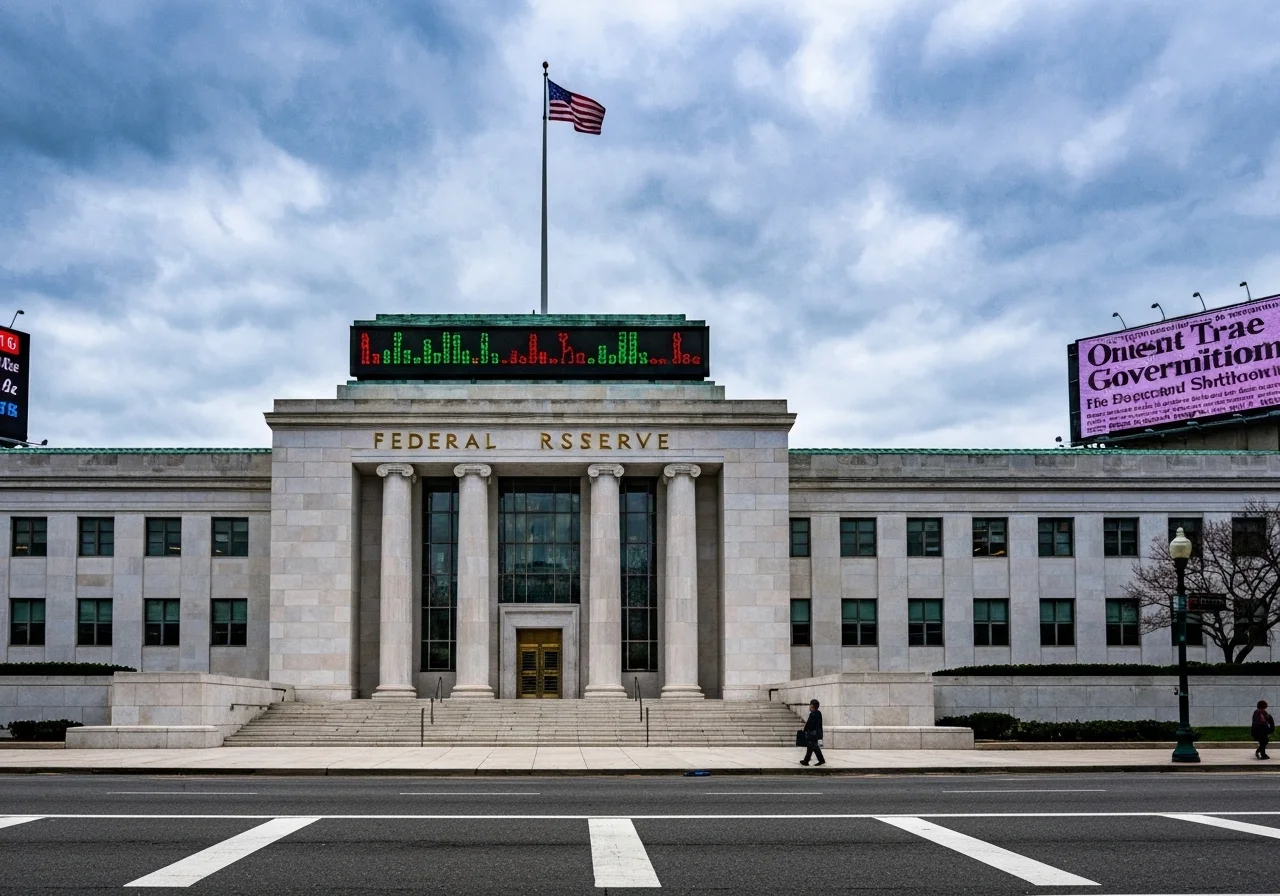
Forward guidance in data vacuum
Navigating without economic data is like flying blindfolded—and Powell’s qualitative guidance has become the only instrument left. With frozen indicators and ADP’s abrupt termination of payroll data sharing, the Fed’s description of "moderate pace" growth, noted by The Guardian, relies purely on anecdotal evidence.
Market participants now dissect Powell’s six recent mentions of "downside risks to employment," per Fortune, as code for impending easing. The paradigm shift here? Communications will likely emphasize financial stability until statistical operations reboot—a risky bet when tariffs and shutdowns cloud the horizon.
Data blackout complicates policy calibration
The Fed's October move will go down in history as the first monetary policy decision made in a statistical blackout. With the government shutdown freezing BLS reports and ADP cutting data ties, policymakers were essentially flying blind—like a pilot navigating thunderstorms with broken instruments. The delayed September CPI (showing stubborn 3% inflation) became the only lifeline, forcing the FOMC to rely on backward-looking data while the economy potentially veered off course. This unprecedented scenario underscores how fragile the Fed's data-dependent framework becomes when its North Star indicators vanish.

Labor market fragility outweighs inflation
Powell's crew made a gutsy call—prioritizing the labor market's cracks over inflation's embers. The 4.3% unemployment print (highest since 2021) revealed a "low-hire, low-fire" economy where businesses play defense, neither expanding nor cutting payrolls aggressively. But here's the kicker: tariffs and immigration policies have effectively shrink-wrapped labor supply and demand simultaneously. When the Fed cites employment stability as the greater risk, it's acknowledging what street-level economists have warned about for quarters—the jobs engine is sputtering while inflation merely idles.

References


Get Daily Event Alerts for Companies You Follow
Free: Register to Track Industries and Investment Opportunities