

Aviation Meltdown: Why Did 6,000 A320s Get Grounded Overnight?
Aviation Meltdown: Why Did 6,000 A320s Get Grounded Overnight?
AI Summary
EASA's emergency directive grounds half the global A320 fleet, revealing software risks in modern aviation. Airlines face operational chaos as 3,000+ flights cancel, prompting urgent reassessment of fleet strategies and cybersecurity protocols.
Keywords
Emergency Airworthiness Directive Issued
EASA Grounds 6,000 A320 Aircraft
The aviation world just got a seismic jolt—EASA’s emergency directive has effectively parked half the planet’s A320 fleet. We’re talking 6,000 birds grounded overnight across 350+ operators, from budget carriers to full-service giants. This isn’t just a hiccup; it’s the largest narrowbody disruption since the 737 MAX fiasco.
The timing couldn’t be worse. Fresh off dethroning Boeing’s 737 in annual deliveries, Airbus now faces a logistical nightmare. Legacy carriers are scrambling to reshuffle fleets, while LCCs stare down massive schedule meltdowns. As NDTV’s deep dive notes, this software crisis exposes the fragility of over-reliance on a single aircraft family—even one as battle-tested as the A320.
<div data-table-slug="airbus-grounding-metrics">| Region | Estimated Aircraft Affected | Primary Operator Types |
|---|---|---|
| Europe | 1,850 | Legacy carriers, LCCs |
| Asia-Pacific | 1,600 | Full-service, hybrids |
| North America | 1,200 | Major network carriers |
| Middle East | 750 | Flag carriers, LCCs |
| Latin America | 600 | Regional specialists |
Software Vulnerability Triggers Recall
Here’s the kicker—this isn’t some minor glitch. Airbus uncovered a flight control system defect so critical it requires physical patching at maintenance hubs. No over-the-air fixes here; each jet needs hands-on attention. Analysts whisper about cascading subsystem risks, suggesting this could be Airbus’s Dieselgate moment for aviation software.
The supply chain dominoes are already falling. With peak travel in full swing, airlines face brutal trade-offs: delay essential updates or cancel thousands of flights. This grounding could redefine how regulators approach aviation cybersecurity, especially for workhorse models like the A320 that dominate global fleets.
Operational Disruptions Across Airlines
Flight Cancellations Cascade Globally
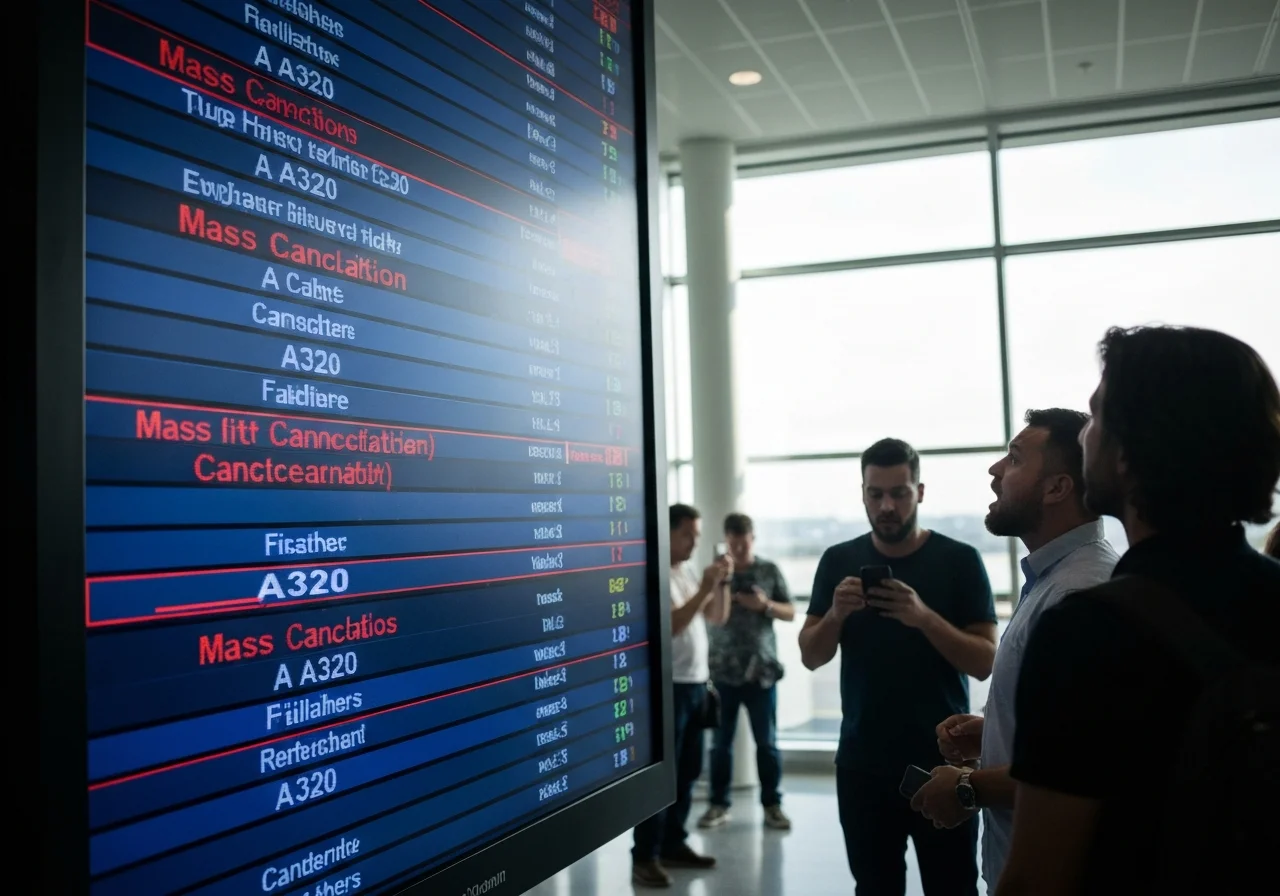
The European Aviation Safety Agency's (EASA) emergency directive sent shockwaves through global aviation networks, with low-cost carriers like Jetstar and Air New Zealand bearing the brunt. Within hours, over 3,000 A320-family aircraft—the workhorses of short-haul aviation—were parked, creating a domino effect of scheduling chaos. Budget airlines operating high-density configurations faced disproportionate impacts, as each grounded plane stranded 180+ passengers. The operational calculus here is brutal: every canceled flight triggers 3-4 downstream crew positioning and maintenance logjams.
Schedule Recovery Requires Days
Aviation networks don’t reboot like computers—Keith Tonkin’s analysis reveals a 72-hour recovery multiplier for every 24 hours of grounding. With the A320 commanding 60% of narrowbody operations, airlines face a triage scenario: premium routes get first dibs on reactivated aircraft, while regional feeders languish. The parallels to the 737 MAX crisis are unavoidable, though the A320’s market penetration amplifies the disruption. Each aircraft requires a half-day software validation—a logistical nightmare when dealing with thousands of frames globally.
Strategic Implications for Aviation Industry
Fleet Management Reassessment Needed
The aviation sector just got a brutal wake-up call—putting all your eggs in one basket is a recipe for turbulence. The grounding of 6,000 Airbus A320 aircraft (half the global fleet) exposes the peril of single-model dependency. With the A320 family gobbling up 60%+ of narrowbody orders since 2015 (NDTV), airlines are learning the hard way that fleet commonality cuts both ways.
This déjà vu moment—echoing the Boeing 737 MAX crisis—reveals how operational efficiency can backfire. Keith Tonkin’s analysis in the Brisbane Times nails it: recovery timelines stretch for days precisely because the A320 dominates like no other aircraft in history.
Software Certification Protocols Scrutinized
When 3,000 A320s were mid-flight during this recall (Canberra Times), it spotlighted a terrifying reality—software flaws don’t wait for maintenance windows. Unlike mechanical issues, digital defects can ground entire fleets in minutes.
CRITICAL SOFTWARE FAILURES
| Incident | Aircraft Model | Year | Impact Duration |
|---|---|---|---|
| Airbus A320 Software | A320 Family | 2025 | Multi-day |
| Boeing 737 MAX MCAS | 737 MAX | 2019 | 20 months |
| Dreamliner Battery | 787 | 2013 | 4 months |
| A380 Wing Cracks | A380 | 2012 | 3 years |
| Qantas A330 Pitch | A330 | 2008 | 6 weeks |
This table isn’t just a historical record—it’s a flashing neon sign for regulators. Expect EASA and FAA to demand Boeing 737 MAX-style audits for all fleet-wide software systems. The digital age of aviation demands bulletproof code, not just airworthy metal.
Aviation Resilience in Digital Age
Balancing Efficiency with Redundancy
The aviation industry's dirty little secret? We've traded robustness for razor-thin margins. The Airbus A320 grounding isn't just another tech hiccup—it's a full-blown wake-up call. When 6,000 birds (half the global A320 fleet) get benched overnight due to a software glitch (NDTV reports), we're staring at the dark side of fleet commonality. This isn't 2013's Boeing 787 battery fires—it's digital dominoes falling faster than ops teams can say "reboot." Aviation guru Keith Tonkin nails it: recovery isn't about swapping parts, but untangling a web of synchronized schedules that "days to recover networks".
Lessons from Historical Groundings
Let's rewind the tape: 1979's DC-10 had metal fatigue, 2013's Dreamliner had thermal runaway, but 2024? We're debugging 3,000 airborne computers (Canberra Times). The scary part? Digital flaws don't play by mechanical rules—they propagate at silicon speed. While airlines chased the holy grail of 60% narrowbody commonality, they forgot to hedge against binary black swans. The takeaway? Redundancy isn't just about spare parts anymore—it's about architectural diversity in an era where one bad line of code can park your entire fleet.

References


Get Daily Event Alerts for Companies You Follow
Free: Register to Track Industries and Investment Opportunities