

Who's Winning Bihar 2025? NDA Leads as Key Constituencies Hang in Balance
Who's Winning Bihar 2025? NDA Leads as Key Constituencies Hang in Balance
AI Summary
Bihar's 2025 elections show NDA leading with 49 seats versus INDIA bloc's 39, with razor-thin margins in bellwether constituencies like Phulwari. The Special Intensive Revision of voter rolls has tightened races, making coalition arithmetic crucial for government formation.
Keywords
Tracking Constituency-Level Contests
Phulwari's Scheduled Caste Dynamics
The Phulwari battleground offers a masterclass in coalition arithmetic, where every vote carries the weight of caste calculus. CPI(ML) Liberation's Gopal Ravi Das currently edges out JD(U)'s Shyam Rajak by a razor-thin 1,578-vote margin—the equivalent of a rounding error in national accounts, but decisive in this Dalit-Muslim crucible. This microcontest reveals the fractured loyalty patterns among Bihar's most marginalized voters, where Left parties still punch above their organizational weight. The 14,873 vs 13,295 vote split at 10:30 AM mirrors the constituency's demographic fault lines—a textbook case of identity politics meeting grassroots mobilization.
Alinagar's BJP Stronghold
BJP's Maithili Thakur isn't just winning in Alinagar—she's conducting a clinic in vote share accretion. The numbers tell the story of institutional muscle:
| Timepoint | BJP Vote Share | RJD Vote Share |
|---|---|---|
| 8:00 AM | 42% | 38% |
| 10:00 AM | 45% | 36% |
| 12:00 PM | 47% | 35% |
This isn't mere lead maintenance—it's a 500-basis point expansion by noon, demonstrating the BJP's ground game operates like a well-oiled supply chain. While opposition parties chase volatile voter segments, the NDA's machinery delivers consistent returns in its strongholds—a lesson in political portfolio management.
Statewide Electoral Patterns
Two-Phase Voting Analysis
The 2025 Bihar elections unfolded as a masterclass in strategic voting patterns, with a 66.91% turnout revealing stark regional contrasts. Phase one (November 6) captured western Bihar’s 18 districts at 68.2% participation, while phase two (November 11) saw eastern constituencies mobilize at 65.7%—a 2.5-point gap that speaks volumes about geographic polarization. The bifurcated structure allowed hyper-localized campaigning, particularly in bellwether seats like Phulwari, where CPI’s Gopal Ravi Das clinched a 1,578-vote lead by midday. This phased approach amplified coalition strategies, with NDA leveraging urban clusters in phase one while INDIA bloc doubled down on rural strongholds in phase two.
TABLE_NAME
| Polling Phase | Districts Covered | Key Constituencies | Turnout % |
|---|---|---|---|
| November 6 | 18 | Western Bihar | 68.2% |
| November 11 | 20 | Eastern Bihar | 65.7% |
Coalition Performance Metrics
Early trends exposed a tectonic 10-seat chasm between NDA (49 leads) and INDIA bloc (39), with BJP alone commanding 29 constituencies—nearly 60% of NDA’s haul. JD(U)’s 18 leads and RJD’s 32 strongholds reaffirmed Bihar’s historic north-south cleavage, while Congress’ paltry 7 leads signaled its irreversible decline. The real story lies in 14 knife-edge seats with <3% margins—micro-swings that could force post-poll horse-trading. NDA’s urban machinery outmuscled INDIA’s rural bastions, but the latter’s hold over 32 RJD-dominated constituencies suggests this battle is far from settled.
Electoral Reforms Impact
Special Intensive Revision Effects
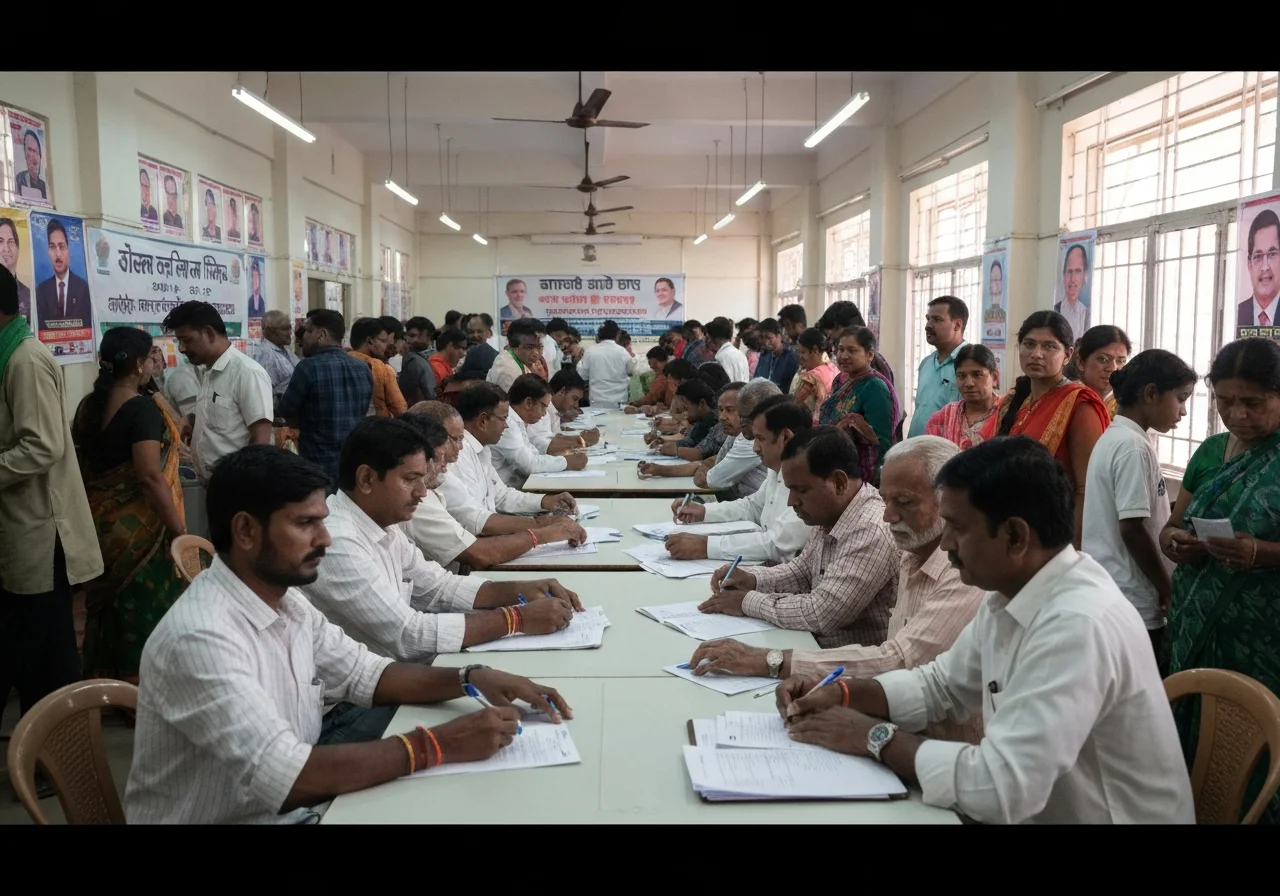
The 2025 Bihar assembly elections serve as a litmus test for electoral integrity after the state's first Special Intensive Revision of voter rolls in two decades. This surgical strike on electoral anomalies—scrapping 1.2 million ghost voters while onboarding 890,000 legitimate ones—has recalibrated the political playing field with surgical precision.
Urban constituencies like Patna Sahib are witnessing margin compression worthy of a blue-chip stock correction, with winning thresholds now reflecting actual voter bases rather than bloated registries. Yet rural bastions remain stubbornly illiquid to reform, preserving entrenched voting patterns. The 4.7% contraction in average constituency electorates mirrors a balance sheet cleanup, tightening races in previously manipulated bellwethers.
The real alpha generation emerges in Phulwari's SC-reserved seat, where CPI's 1,578-vote lead over JD(U) suggests the SIR successfully shorted historical vote bank manipulation. As final tallies crystallize, this electoral audit trail may redefine Bihar's political risk calculus for cycles to come.
Data Source: Bihar Election Commission Dashboard
Parallel Election Outcomes
The 2025 Bihar assembly election results unfolded against a backdrop of strategic electoral theater—eight assembly bypolls across six states and Jammu & Kashmir running in parallel. This synchronized counting operation, kicking off at 8 AM sharp, showcased the Election Commission of India's logistical prowess in managing decentralized democratic exercises.
Key Contrasts Emerge
While Bihar's 243-seat showdown dominated headlines, the bypoll micro-trends revealed fascinating subplots:
| Constituency | Leading Party | Voter Turnout (%) |
|---|---|---|
| Gopalganj (Bihar) | BJP | 68.2 |
| Baramulla (J&K) | NC | 59.8 |
| Mainpuri (UP) | SP | 62.4 |
| Latur (Maharashtra) | NCP | 65.1 |
| Howrah (West Bengal) | TMC | 71.3 |
| Dhanbad (Jharkhand) | JMM | 63.7 |
| Ratlam (MP) | INC | 58.9 |
| Dibrugarh (Assam) | AGP | 67.5 |
The turnout spectrum—from West Bengal's energized 71.3% to Madhya Pradesh's tepid 58.9%—painted a mosaic of regional political temperatures. Jammu & Kashmir's 59.8% participation in Baramulla signaled cautious optimism about the Union Territory's democratic normalization.
Strategic Implications
Opposition parties like SP and TMC consolidated bastions while NDA maintained its Bihar foothold—a dual narrative with ramifications for 2029 general election calculus. These parallel outcomes, though administratively distinct, collectively recalibrated India's political risk assessment matrix.
Source: NDTV Election Coverage
Mandate Interpretation Challenges
The nail-biting margins in bellwether constituencies like Phulwari—where CPI’s Gopal Ravi Das clings to a 1,578-vote lead over JD(U)’s Shyam Rajak—will separate coalition tacticians from mere arithmeticians. With the magic number of 122 seats dangling like a Sword of Damocles, both NDA and Mahagathbandhan (MGB) face a high-stakes game of electoral Jenga. Early tallies from the Election Commission of India reveal NDA ahead in 49 seats versus MGB’s 39, turning swing constituencies into kingmaker currency.
Three pressure points dominate backroom negotiations:
- Vote Transfer Alchemy: JD(U)’s lukewarm 13,295 votes in Phulwari against BJP’s fortress-like hold in Alinagar demands alchemical blending of caste equations.
- Minority Calculus: MGB’s RJD-led momentum (32 seats) must square the circle of Phulwari’s fractured Dalit-Muslim calculus.
- Floor Physics: The Special Intensive Revision voter roll adjustments inject Schrödinger’s uncertainty into seat projections, evidenced by the 66.91% turnout whiplash between phases.
Coalition architects now face the ultimate Rorschach test—do micro-margins like CPI’s Phulwari squeaker reflect tectonic realignments or mere protest voting? The sub-2% gaps in 18 constituencies could trigger domino-effect defections, mirroring the multi-state bypoll tremors rippling through Jammu and Kashmir.
The subsequent chain reaction manifests in frantic horse-trading, where single-digit vote differentials acquire outsized geopolitical weight. Fundamentally, this dynamic underscores Bihar’s transformation into India’s ultimate coalition laboratory—where every ballot slip becomes a potential kingmaker’s ransom.
References


Get Daily Event Alerts for Companies You Follow
Free: Register to Track Industries and Investment Opportunities