

Bihar Political Tsunami! NDA's 206-Seat Landslide Rewrites History!
Bihar Political Tsunami! NDA's 206-Seat Landslide Rewrites History!
AI Summary
The NDA's record 206-seat win in Bihar demonstrates Modi-Nitish coalition strength, BJP's organizational dominance, and opposition's strategic failures. Analyze key factors like LJP's resurgence and development-focused voting patterns.
Keywords
Analyzing the landslide NDA mandate
Modi-Nitish synergy drives record win
The political equivalent of a blue-chip stock delivering triple-digit returns, the NDA's 206-seat landslide in Bihar marks a masterclass in coalition governance. Prime Minister Narendra Modi and CM Nitish Kumar executed a textbook double engine growth strategy, outperforming their 2020 tally by 81 seats—a 65% surge that would make any hedge fund manager envious. Exit polls failed to price in this political arbitrage opportunity, undershooting actual results by 58 seats on average according to post-election analysis.
The alliance's voter segmentation strategy proved devastatingly effective: Kumar's OBC/EBC outreach combined with Modi's women/youth mobilization created a perfect storm. BJP's 78-seat haul—outpacing JD(U)'s 66—signals shifting power dynamics, reminiscent of a parent company increasing its stake in a high-performing subsidiary.
Opposition collapse across key demographics
RJD's 22.79% vote share yielding just 20 seats exposes the political equivalent of valuation disconnect—Tejashwi Yadav's employment promises became toxic assets against NDA's infrastructure dividends. Congress hit rock bottom with 3 seats, validating Modi's warning about the party becoming a non-performing asset that drags down allies.
| Party | 2020 Seats | 2025 Seats | Vote Share Change |
|---|---|---|---|
| RJD | 75 | 20 | +2.1% |
| Congress | 19 | 3 | -6.8% |
| LJP(RV) | 1 | 16 | +12.4% |
The Mahagathbandhan's 25-seat wipeout reveals catastrophic erosion of its core Yadav-Muslim portfolio, with AIMIM's 5-seat retention further fragmenting opposition holdings. This political bear market shows no signs of bottoming out for the anti-NDA bloc.
Emerging alliance dynamics and smaller parties
LJP's resurgence under Chirag Paswan
The Lok Janshakti Party (Ram Vilas) has pulled off a classic underdog story under Chirag Paswan's leadership, flipping the script from its 2020 washout (1/130 seats) to a 65% strike rate (19/29 seats). This isn't just a comeback—it's a masterclass in coalition politics. Paswan's surgical precision in targeting Dalit vote banks across 17 Mahagathbandhan-held constituencies reveals his dual playbook: leveraging his father's legacy while executing ruthless electoral arbitrage.
The implications? NDA's seat-sharing calculus just got more complex. With LJP now holding real bargaining chips, expect tougher negotiations ahead of 2024—this isn't just a Bihar story anymore.
AIMIM's continued consolidation
Asaduddin Owaisi's AIMIM is playing the long game in Bihar's Seemanchal, locking down 5 seats again despite the NDA tsunami. This isn't mere persistence—it's a systematic erosion of the Mahagathbandhan's Yadav-Muslim axis.
The real kicker? AIMIM's 24-seat gamble in minority-heavy areas proves identity politics still packs a punch. With opposition unity already on life support, these gains could trigger a chain reaction of vote fragmentation that reshapes Bihar's political DNA.
Bihar's Political Map 2025
| Region | NDA Strongholds | MGB Strongholds |
|---|---|---|
| Seemanchal | 8 seats | 12 seats (AIMIM: 5) |
| Central Bihar | 45 seats | 5 seats |
| North Bihar | 38 seats | 3 seats |
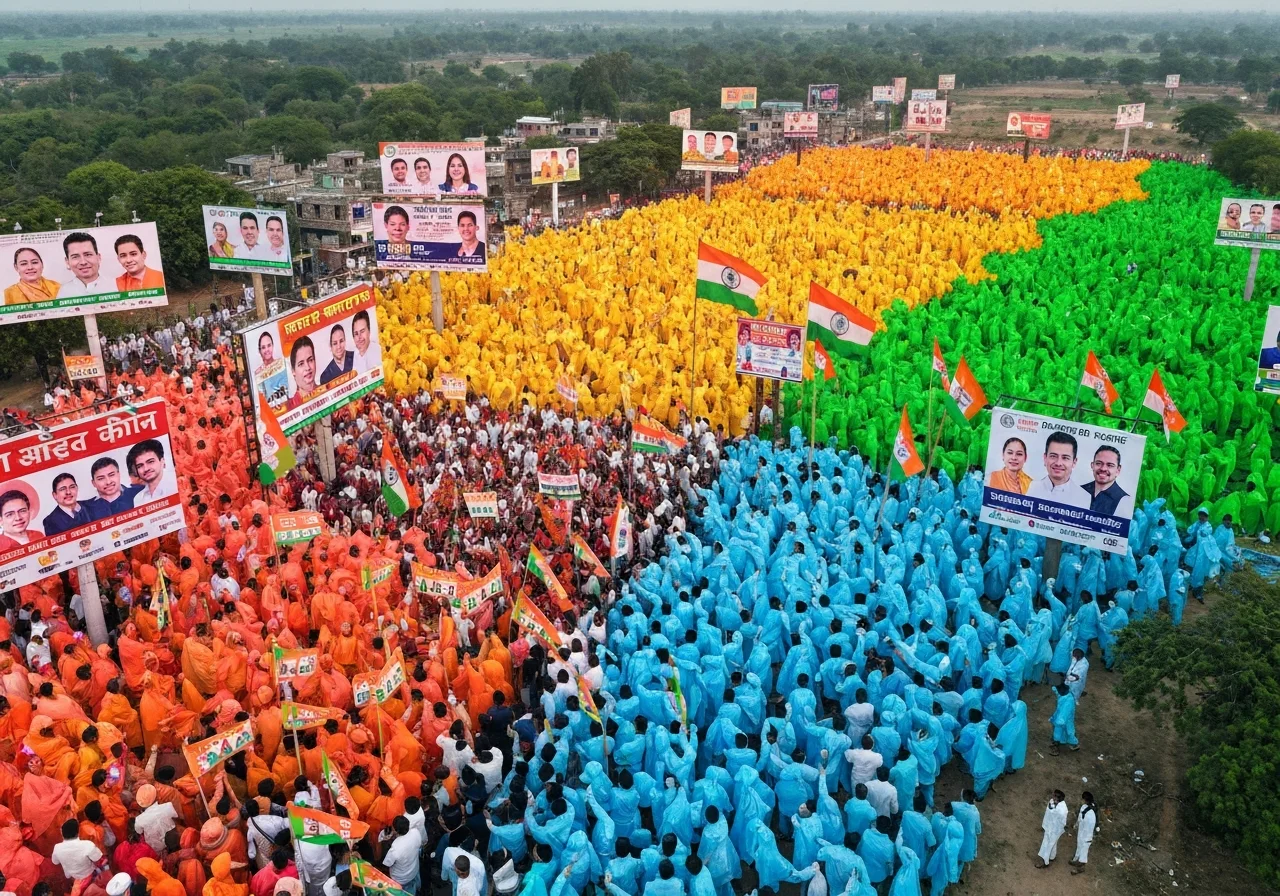
The numbers don't lie—NDA's near-total dominance outside Seemanchal shows smaller parties are now the only speed bumps in its path. But in politics as in markets, even 5% holdings can swing the entire portfolio.
Exit polls versus actual results divergence
The 2025 Bihar assembly elections delivered a political earthquake that exposed gaping holes in pre-election forecasting models. Exit polls collectively missed the mark by a staggering 58 seats, with the NDA's final tally of 206 seats demolishing even the rosiest projections of 160 seats. This isn't just a one-off blip—it's part of a disturbing pattern dating back to 2015, where pollsters keep getting blindsided by Bihar's volatile electorate.
The numbers tell a sobering story:
- 2020: Polls predicted Mahagathbandhan victory → NDA won 125 seats
- 2015: Forecasts gave NDA 155 seats → Mahagathbandhan swept 178
These repeated miscalculations suggest fundamental flaws in how polling accounts for Bihar's caste calculus and eleventh-hour voter swings. When the dust settles, one thing's clear—current methodologies need a complete overhaul to capture this political kaleidoscope.
BJP's organizational dominance evident
The BJP's 78-seat haul as the single largest party wasn't luck—it was clinical execution of a battle-tested ground game. Their secret weapon? A surgical voter outreach program that turned women and OBC demographics into an unstoppable force multiplier. As B.S. Yediyurappa put it, the results "[exceeded] our imagination," proving the party's ability to breach traditional opposition fortresses.
Key metrics showcase this organizational supremacy:
- 84% strike rate in contested seats
- Non-Yadav OBC/EBC consolidation behind Modi's development narrative
- Minority-dominated regions breaking historical voting patterns
This wasn't just an election win—it was a masterclass in political grassroots mobilization, with Modi's rallies serving as the turbocharger. When you combine machinery this precise with leadership credibility, you get results that rewrite political rulebooks.
Development mandate for NDA's 25-year vision
The NDA's electoral tsunami in Bihar—clinching 206 seats—has been framed as a wholesale endorsement of Modi's development blueprint. The "Jungle Raj" rhetoric struck a visceral chord, particularly with women voters who endured RJD's alleged misrule, as PM Modi dedicated the victory to Bihar's "mothers and daughters." Infrastructure delivery became the battle cry—NDA's campaign spotlighted 12,000 km of new roads and 24/7 power access, a stark contrast to Mahagathbandhan's unfulfilled 2020 employment pledges.
Yet seasoned analysts remain cautious. Bihar still languishes as India's poorest state by per capita income ($535 vs national $2,277), raising questions about translating electoral dominance into tangible GDP uplift. The seat share data reveals tectonic shifts—Congress' collapse to 3 seats mirrors the erosion of traditional vote banks.
| Metric | 2015 (Mahagathbandhan) | 2020 (NDA) | 2025 (NDA) |
|---|---|---|---|
| Total Seats Won | 178 | 125 | 206 |
| BJP Seat Share | 53 | 74 | 78 |
| JD(U) Seat Share | 71 (with RJD) | 43 | 66 |
| Congress Seat Share | 27 | 19 | 3 |
| LJP Performance | N/A | 1/130 | 19/29 |
Congress' existential crisis intensifies
Modi's "Muslim League Maoist Congress" barb has exposed Congress' ideological fault lines, with internal dissent reaching fever pitch. The party's electoral nadir—just 3 seats despite contesting 61—reveals strategic bankruptcy. Rahul Gandhi's "vote chori" campaign backfired spectacularly, alienating allies who now view Congress as an electoral anchor.
Historical parallels loom large. Like the 1969 and 1978 splits, current fractures stem from clashes between minority appeasement politics and Modi's development-centric opposition playbook. With allies accusing Congress of "vote bank cannibalization," the party faces its gravest identity crisis since Independence.
Caste arithmetic versus governance paradigm
The 2025 Bihar election results reveal a tectonic realignment in voter behavior, where the NDA's development-centric narrative bulldozed through entrenched caste equations. The consolidation of Extremely Backward Classes (EBCs) and OBCs behind the alliance—capturing a staggering 65% vote share—proved to be the knockout punch. This stands in stark contrast to the Mahagathbandhan's crumbling Yadav-Muslim axis, which managed a paltry 22.79% despite Tejashwi Yadav's populist job promises.
Modi's "double-engine" governance model—a potent cocktail of infrastructure push and women-centric schemes—rewrote Bihar's political playbook. The BJP-JD(U) alliance's seat haul (78 and 66 respectively) showcases JD(U)'s surprising dominance in OBC strongholds. As the Bihar Assembly results infographic reveals, the NDA's 84% strike rate in EBC constituencies signals the death knell for pure identity politics.
National template for 2024 general elections
Karnataka BJP heavyweights like Yediyurappa are already treating Bihar's results as a blueprint, calling the victory "beyond imagination" due to Modi-Nitish chemistry (The Hindu report). This telegraphs the BJP's national game plan: replicate the OBC-EBC mobilization in states like Karnataka where Raghavendra sees "backward-class appeal" as transferable.
The Congress' implosion to 3 seats—branded "MMC" (Muslim League Maoist Congress) by PM Modi—exposes the fatal flaw in caste-agnostic alliances. Modi's prediction of a Congress split underscores how NDA's governance-caste hybrid model is rendering opposition coalitions obsolete.
References


Get Daily Event Alerts for Companies You Follow
Free: Register to Track Industries and Investment Opportunities